El Metro de Santo Domingo: Una Solución que ya Existe, un Proyecto que lo Desconecta Santo Domingo Metro: An Existing Solution, a Project that Disconnects It
Síntesis EjecutivaExecutive Synopsis
Resumen de los tres niveles de evidencia y la pregunta centralSummary of three evidence levels and the central question
Este documento distingue explícitamente tres niveles de información para que el lector pueda distinguir entre lo que está probado, lo que se calcula y lo que se deduce.This document explicitly distinguishes three information levels so the reader can tell what is proven, calculated, and inferred.
Datos verificables de fuentes primarias: contratos, comunicados oficiales, estudios de prefactibilidad publicados.Verifiable data from primary sources: contracts, official communications, published feasibility studies.
Estimaciones basadas en parámetros operativos y supuestos explícitos con fuentes metodológicas.Estimates based on operational parameters and explicit assumptions with methodological sources.
Conclusiones derivadas de la comparación entre hechos y modelos, formuladas como hipótesis fundamentadas.Conclusions derived from comparing facts and models, framed as grounded hypotheses.
Este análisis no predice: diagnostica las consecuencias matemáticas de las decisiones ya tomadas y documentadas en el expediente oficial. Los hechos que se observan hoy son la manifestación de parámetros físicos que estaban fijados desde la firma del contrato.This analysis does not predict: it diagnoses the mathematical consequences of decisions already made and documented in the official file. The facts observed today are the manifestation of physical parameters fixed since contract signing.
El Metro opera con 52 trenes Alstom transportando 400,000 pasajeros diarios. El estudio METI/NIPPON KOEI (feb. 2024) proyecta 464,800 pasajeros diarios para 2030.The Metro operates 52 Alstom trains carrying 400,000 daily passengers. The METI/NIPPON KOEI study (Feb 2024) projects 464,800 daily passengers for 2030.
El monorriel con 17 trenes de 750 pax y headway 3.53 min alcanzaría 306,000 pasajeros diarios — inferior a la demanda proyectada y al Metro actual.The monorail with 17 trains of 750 pax and 3.53 min headway would reach 306,000 daily passengers — below projected demand and the current Metro.
El Metro existente cubre el 86.1% de la demanda 2030. El monorriel cubriría solo el 65.8%. La restricción de capacidad es estructural desde el Día 1.The existing Metro covers 86.1% of 2030 demand. The monorail would cover only 65.8%. The capacity constraint is structural from Day 1.
| ConceptoItem | Monorriel (6 vagones)Monorail (6 cars) | Metro (6 vagones)Metro (6 cars) | NaturalezaNature |
|---|---|---|---|
| Capacidad por trenCapacity per train | 750 pax | 1,200 pax ⚠ N3 | N3 |
| Flota (modelo)Fleet (model) | 17 trenes | 17 trenes | N2 |
| Headway | 3.53 min | 3.53 min | N2 |
| Capacidad diaria estimadaDaily capacity (est.) | 306,000 | 490,000 | N3 |
| Demanda METI 2030METI 2030 demand | 464,800 | N1 | |
| Cobertura 20302030 coverage | 65.8% | 105.4% | N3 |
La Pregunta que el Expediente No RespondeThe Question the File Doesn't Answer
"¿Por qué se está construyendo un sistema con capacidad estimada inferior a la demanda proyectada, cuando el Metro existente ya cubre el 86% de esa demanda y cuenta con un contrato de mantenimiento que garantiza su operación?" "Why is a system being built with estimated capacity below projected demand, when the existing Metro already covers 86% of that demand and has a maintenance contract guaranteeing its operation?"
La respuesta no se encuentra en los documentos examinados.The answer is not found in the documents examined.
Nivel 1 — Hechos DocumentadosLevel 1 — Documented Facts
Datos verificables provenientes de fuentes primarias con citación exactaVerifiable data from primary sources with exact citation
"A diario las dos líneas de Metro, operadas por la OPRET con una flota de 52 trenes Metropolis de Alstom, transportan alrededor de 400.000 pasajeros."
Los 400,000 pasajeros corresponden a las Líneas 1 y 2 combinadas, no exclusivamente al corredor de la Línea 3 analizado por METI.The 400,000 passengers correspond to Lines 1 and 2 combined, not exclusively to the Line 3 corridor analyzed by METI.
Precisión de flota: 52 trenes corresponde a la flota del contrato de mantenimiento Alstom (Alstom PR, 20 mayo 2024). Fuentes independientes a marzo 2025 reportan 46 unidades en servicio operativo. La diferencia refleja unidades en mantenimiento programado vs. flota total del contrato.Fleet precision: 52 trains corresponds to the Alstom maintenance contract fleet (Alstom PR, May 20, 2024). Independent sources as of March 2025 report 46 units in active service. The difference reflects scheduled maintenance units vs. total contract fleet.
| AñoYear | Demanda diariaDaily demand | PPHPD | Demanda anualAnnual demand | CAGR |
|---|---|---|---|---|
| 2030 | 464,800 | 12,800 | 153 M | — |
| 2045 | 571,100 | 16,200 | 188 M | 1.38% |
| 2060 | 704,000 | 20,600 | 232 M | 1.40% |
| Tasa ponderada 2030–2060Weighted rate 2030–2060 | ~1.39% | |||
Calculado como (704,000/464,800)^(1/30)−1 = 1.3935%. Tasa estable entre los dos períodos (1.38%–1.40%), lo que indica consistencia interna del modelo METI.Calculated as (704,000/464,800)^(1/30)−1 = 1.3935%. Stable rate across both periods (1.38%–1.40%), indicating METI model internal consistency.
Nivel 2 — Modelos de CálculoLevel 2 — Calculation Models
Estimaciones con parámetros y supuestos explícitosEstimates with explicit parameters and assumptions
El siguiente modelo estima la capacidad operativa de una configuración de 17 trenes de 750 pasajeros. Los parámetros de flota (17 trenes, 750 pax/tren) provienen del expediente oficial SNIP 17248. El headway resultante es una derivación matemática directa de esa flota, no un supuesto del modelo. La ingeniería inversa aplicada calcula las consecuencias operativas de los parámetros fijados por el Estado.This model estimates the operational capacity of a 17-train configuration of 750 passengers each. The fleet parameters (17 trains, 750 pax/train) come from the official SNIP 17248 file. The resulting headway is a direct mathematical derivation of that fleet, not a model assumption. The reverse engineering applied calculates the operational consequences of the parameters set by the State.
Headway derivado del ciclo operativo: El expediente fija una flota de 17 trenes y un ciclo operativo de 60 minutos (recorrido ida + retorno + detenciones comerciales + giro en terminales + regulación + margen de recuperación). Bajo esos parámetros, el headway matemáticamente derivado es: H = T ÷ N = 60 min ÷ 17 trenes = 3.53 min. No es un supuesto elegido por el autor — es una consecuencia aritmética de los parámetros del expediente. Compatible con benchmarks UITP de referencia para sistemas automatizados GoA3/GoA4.Headway derived from the operational cycle: The file sets a fleet of 17 trains and an operational cycle of 60 minutes (outbound + return trip + commercial stops + terminal turns + regulation + recovery margin). Under those parameters, the mathematically derived headway is: H = T ÷ N = 60 min ÷ 17 trains = 3.53 min. It is not an assumption chosen by the author — it is an arithmetic consequence of the file's parameters. Compatible with UITP reference benchmarks for GoA3/GoA4 automated systems.
4 horas pico (2 mañana + 2 tarde) concentran el 30% de la demanda diaria total. Las otras 16–20 horas absorben el 70% restante con frecuencias menores. El modelo dimensiona para el pico sin sobredimensionar la jornada completa.4 peak hours (2 morning + 2 afternoon) concentrate 30% of total daily demand. The remaining 16–20 hours absorb 70% at lower frequencies. The model sizes for peak without over-dimensioning the full day.
Factor del 30% compatible con benchmarks UITP para corredores urbanos de alta densidad. Headway de 3.53 min consistente con rangos operativos de referencia para sistemas GoA3/GoA4 según IEC 62267 — norma de automatización, no de headway operacional universal.30% factor compatible with UITP benchmarks for high-density urban corridors. 3.53 min headway consistent with reference operational ranges for GoA3/GoA4 systems per IEC 62267 — an automation standard, not a universal operational headway standard.
Nivel 3 — Inferencias TécnicasLevel 3 — Technical Inferences
Conclusiones derivadas de la comparación entre hechos y modelosConclusions derived from comparing facts and models
La restricción de capacidad no es un riesgo futuro — es una brecha estructural desde el Día 1. El proyecto propuesto tiene menor capacidad estimada que la demanda proyectada y que el sistema actual.The capacity constraint is not a future risk — it is a structural gap from Day 1. The proposed project has lower estimated capacity than projected demand and the current system.
| SistemaSystem | FlotaFleet | Headway | Pax/trenPax/train | Pax/día est.Pax/day est. |
|---|---|---|---|---|
| Monorriel (proyecto)Monorail (project) | 17 | 3.53 min | 750 | 306,000 |
| Metro 6 vagonesMetro 6 cars | 17 | 3.53 min | 1,200 | 490,000 |
| Metro actual (dato)Current Metro (data) | 52 | — | — | 400,000 |
Con la misma flota y el mismo headway, una configuración de Metro de 6 vagones tendría una capacidad estimada 60% superior al monorriel. La diferencia no es de frecuencia — es de capacidad física por tren.With the same fleet and headway, a 6-car Metro configuration would have 60% higher estimated capacity than the monorail. The difference is not frequency — it is physical capacity per train.
| ConfiguraciónConfiguration | Pax/día est.Pax/day est. | Cobertura 20602060 coverage | EvaluaciónAssessment |
|---|---|---|---|
| Monorriel (proyecto)Monorail (project) | 306,000 | 43% | InsuficienteInsufficient |
| Metro 6 vagonesMetro 6 cars | 490,000 | 70% | ParcialPartial |
| Metro 8 vagonesMetro 8 cars | 653,000 | 93% | Óptimo (Panamá)Optimal (Panama) |
El FITRAM anunció modificaciones al trazado original (Fuente: Diario Libre, 13 jul. 2026 · diariolibre.com): el monorriel ya no iniciará en el Centro Olímpico — nodo de intersección L1+L2 — sino desde la estación Coronel Rafael Tomás Fernández Domínguez (Av. San Martín), conectando únicamente con la Línea 2. El trazado definitivo está pendiente de proceso de consulta comunitaria.
El propio estudio METI/Nippon Koei (pág. 61, sección 03-3.4) identifica el Centro Olímpico como la estación de mayor demanda del corredor — precisamente por ser el punto de transferencia con la Línea 1.
Este escenario fue presentado como inferencia técnica (N3) en noviembre 2025. El cambio anunciado es consistente con el mecanismo descrito. El anuncio de FITRAM de julio 2026 es un hecho N1 documentado; la inferencia del autor permanece en N3.
Nota de precisión: La motivación declarada por el FITRAM es ambiental y comunitaria. Este análisis documenta la consistencia entre el mecanismo inferido y el cambio anunciado — sin afirmar causalidad.This scenario was presented as a technical inference (N3) in November 2025. The announced change is consistent with the described mechanism. FITRAM's July 2026 announcement is a documented N1 fact; the author's inference remains at N3.
Precision note: FITRAM's stated motivation is environmental and community-based. This analysis documents the consistency between the inferred mechanism and the announced change — without asserting causality.
Si se mantiene la integración con L1, el volumen excede la capacidad estimada del monorriel (306,000 vs. >400,000 demanda efectiva).If integration with L1 is maintained, volume exceeds monorail estimated capacity (306,000 vs. >400,000 effective demand).
La eliminación de la interconexión con la Línea 1 modifica la demanda efectiva atribuible al corredor y, por tanto, puede alterar la comparación entre capacidad y demanda. La motivación declarada por FITRAM para esta modificación es ambiental y comunitaria — este análisis documenta el efecto funcional potencial sin afirmar causalidad.The elimination of the Line 1 interconnection modifies the effective demand attributable to the corridor and may therefore alter the comparison between capacity and demand. FITRAM's stated motivation for this modification is environmental and community-based — this analysis documents the potential functional effect without asserting causality.
40 trenes/hora. Sin validación operativa documentada en sistemas GoA4 de esta escala.40 trains/hour. No documented operational validation in GoA4 systems at this scale.
17 trenes/hora. Compatible con benchmarks UITP de referencia. Cubre 12,750 pphpd.17 trains/hour. Compatible with UITP reference benchmarks. Covers 12,750 pphpd.
En 90 segundos, un tren debe detenerse, abrir puertas, intercambiar cientos de pasajeros, cerrar puertas, verificar sensores, acelerar, despejar el bloque de seguridad, y el tren siguiente debe mantener distancia de frenado de emergencia. Solo el proceso de embarque y desembarque consume aproximadamente 45 segundos en hora pico, dejando ~40 segundos para todo lo demás.
Este ciclo debe ejecutarse sincronizadamente en cada una de las estaciones. Si una sola estación se desalinea — por demanda inusual, incidente menor o cualquier variación operativa — el headway se rompe para toda la red simultáneamente. No es un problema de una estación: es un problema de sistema.
La ausencia de validación operativa documentada en sistemas GoA4 de esta escala no es un detalle menor: es la diferencia entre una promesa contractual y un parámetro de ingeniería verificado.In 90 seconds, a train must stop, open doors, exchange hundreds of passengers, close doors, verify sensors, accelerate, clear the safety block, and the next train must maintain emergency braking distance. The boarding and alighting process alone consumes approximately 45 seconds during peak hours, leaving ~40 seconds for everything else.
This cycle must execute synchronously at every station simultaneously. If a single station falls out of alignment — due to unusual demand, a minor incident, or any operational variation — the headway breaks for the entire network at once. It is not a single-station problem: it is a system-wide problem.
The absence of documented operational validation in GoA4 systems at this scale is not a minor detail: it is the difference between a contractual promise and a verified engineering parameter.
Una cláusula de garantía operativa que transfiera al contratista el riesgo financiero de no alcanzar el headway prometido de 90 segundos protegería al Estado del déficit operativo.An operational guarantee clause transferring to the contractor the financial risk of not achieving the promised 90-second headway would protect the State from operational deficit.
Comparación entre el trazado original presentado por el gobierno (agosto 2025–enero 2026) y el trazado anunciado por el FITRAM en julio de 2026. Todos los datos son oficiales y verificables.Comparison between the original route presented by the government (August 2025–January 2026) and the route announced by FITRAM in July 2026. All data is official and verifiable.
| AspectoAspect | Diseño original (ago. 2025–ene. 2026)Original design (Aug. 2025–Jan. 2026) | Trazado anunciado (jul. 2026)Announced route (Jul. 2026) |
|---|---|---|
| Punto de partidaStarting point | Centro Olímpico Juan Pablo DuarteJuan Pablo Duarte Olympic Center | Estación Coronel Rafael Tomás Fernández Domínguez (Av. San Martín)Coronel Rafael Tomás Fernández Domínguez station (San Martín Ave.) |
| Conexión con el MetroMetro connection | Líneas 1 y 2Lines 1 and 2 | Solo Línea 2Line 2 only |
| Número de estacionesNumber of stations | 12–13 | 11 |
| Configuración de vagonesCar configuration | 4 vagones (ampliables a 6)4 cars (expandable to 6) | 6 vagones desde el inicio6 cars from day one |
| Trazado principalMain route | Av. John F. Kennedy · Leopoldo Navarro · 30 de Marzo · Parque Enriquillo · Puente Juan CarlosJohn F. Kennedy Ave. · Leopoldo Navarro · 30 de Marzo · Parque Enriquillo · Juan Carlos Bridge | Bifurcación Av. Coronel Rafael Fernández Domínguez · Av. Ecológica · Charles de GaulleCoronel Rafael Fernández Domínguez Ave. fork · Ecological Ave. · Charles de Gaulle |
Diseño original: Listín Diario, 28 ago. 2025 · fitram.gob.do (sep. 2025) · Diario Libre, 26 mar. 2026. Trazado anunciado: Diario Libre, 13 jul. 2026 (diariolibre.com/3598605) · El Caribe, jul. 2026.Original design: Listín Diario, Aug. 28, 2025 · fitram.gob.do (Sep. 2025) · Diario Libre, Mar. 26, 2026. Announced route: Diario Libre, Jul. 13, 2026 (diariolibre.com/3598605) · El Caribe, Jul. 2026.
El estudio METI (pág. 61, sección 03-3.4) identifica el Centro Olímpico como la estación de mayor demanda del corredor por ser el punto de transferencia con la Línea 1. El trazado anunciado elimina precisamente ese nodo. La motivación declarada por el FITRAM es ambiental y comunitaria. Este análisis documenta la consistencia entre el mecanismo inferido en noviembre 2025 y el cambio anunciado en julio 2026 — sin afirmar causalidad.The METI study (p. 61, section 03-3.4) identifies the Olympic Center as the highest-demand station in the corridor because it is the Line 1 transfer point. The announced route eliminates precisely that node. FITRAM's stated motivation is environmental and community-based. This analysis documents the consistency between the mechanism inferred in November 2025 and the change announced in July 2026 — without asserting causality.
El estudio METI/Nippon Koei de febrero de 2024 evaluó cinco opciones para el corredor L3. El Monorriel obtuvo 24/50 —equivalente a 48/100— y ocupó el último lugar, en una evaluación que contemplaba el nodo Centro Olímpico como punto de integración con las Líneas 1 y 2. La documentación pública inicial de FITRAM también presentaba Centro Olímpico como terminal de la primera etapa y conexión con ambas líneas del Metro. [FITRAM] The METI/Nippon Koei study of February 2024 evaluated five options for the L3 corridor. The Monorail received 24/50 —equivalent to 48/100— and ranked last, in an evaluation that considered the Olympic Center node as an integration point with Lines 1 and 2. FITRAM's initial public documentation also presented the Olympic Center as the first-stage terminal and connection to both Metro lines. [FITRAM]
En julio de 2026, FITRAM anunció una modificación del trazado que elimina ese nodo de integración [Diario Libre, 13 jul 2026]. Dado que la puntuación original dependía de variables como demanda, conectividad, transferencias y beneficio de red, la nota de 24/50 no puede trasladarse automáticamente al trazado modificado sin una reevaluación formal bajo la matriz y los pesos originales de METI. In July 2026, FITRAM announced a route modification that eliminates that integration node [Diario Libre, Jul 13, 2026]. Since the original score depended on variables such as demand, connectivity, transfers, and network benefit, the 24/50 score cannot be automatically transferred to the modified route without a formal reevaluation under METI's original matrix and weights.
Una puntuación inferior a 48/100 constituye una hipótesis técnicamente razonable si la pérdida de integración no queda compensada por beneficios verificables en otros criterios. Al momento de esta revisión, no se ha identificado públicamente una reevaluación METI actualizada del trazado modificado. A score below 48/100 constitutes a technically reasonable hypothesis if the loss of integration is not compensated by verifiable benefits in other criteria. As of this review, no updated METI reevaluation of the modified route has been publicly identified.
La hipótesis de una puntuación inferior a 48/100 no constituye una nueva evaluación METI. Expresa la necesidad de recalcular la matriz original con los parámetros, demanda, conectividad y criterios aplicables al trazado modificado. The hypothesis of a score below 48/100 does not constitute a new METI evaluation. It expresses the need to recalculate the original matrix with the parameters, demand, connectivity, and criteria applicable to the modified route.
24/50 no debe interpretarse como la puntuación del trazado actualmente anunciado. Es la puntuación obtenida por el Monorriel dentro de la configuración evaluada por METI en 2024. 24/50 should not be interpreted as the score for the currently announced route. It is the score obtained by the Monorail within the configuration evaluated by METI in 2024.
El cambio posterior de trazado modificó, entre otros elementos, el nodo de integración con la red existente. Por ello, existen dos posibilidades: The subsequent route change modified, among other elements, the integration node with the existing network. Therefore, there are two possibilities:
La cuestión verificable es determinar cuál de las dos ocurrió. The verifiable question is to determine which of the two occurred.
Si existe la reevaluación, debe poder identificarse el documento, sus parámetros, pesos y resultados. Si no existe, permanece abierta la cuestión de la comparabilidad entre la evaluación METI de 2024 y el trazado actualmente propuesto. If the reevaluation exists, the document, its parameters, weights, and results must be identifiable. If it does not exist, the question of comparability between the 2024 METI evaluation and the currently proposed route remains open.
Gráficos del AnálisisAnalysis Charts
Visualización de los datos del Nivel 1 y proyecciones del Nivel 2/3Visualization of Level 1 data and Level 2/3 projections
El gráfico asume misma flota (17 trenes) y mismo headway (3.53 min) para Metro y Monorriel.
La ventaja del Metro es exclusivamente de capacidad física por tren (1,200 vs 750 pax).
Escalabilidad operativa adicional: reducir el headway de 3.53 min a 2.5 min
equivale a un +41% de capacidad (490,000 → 691,200 pax/día),
llevando al Metro 6 vagones a cubrir el 98% de la demanda proyectada para 2060
— sin necesidad de cambiar la infraestructura ni la flota de vagones.
El Monorriel, con el mismo ajuste de headway, alcanzaría solo 432,000 pax/día
(61% de la demanda 2060).
The chart assumes same fleet (17 trains) and same headway (3.53 min) for Metro and Monorail.
The Metro advantage is exclusively physical capacity per train (1,200 vs 750 pax).
Additional operational scalability: reducing headway from 3.53 min to 2.5 min
equals +41% capacity (490,000 → 691,200 pax/day),
bringing the Metro 6-car to cover 98% of projected 2060 demand
— without changing infrastructure or car fleet.
The Monorail, with the same headway adjustment, would reach only 432,000 pax/day
(61% of 2060 demand).
Ecosistema de ProductosProduct Ecosystem
Acceso directo a todos los productos del análisis — escanea el QR o haz clic en los enlacesDirect access to all analysis products — scan the QR or click the links

Fuentes DocumentalesDocumentary Sources
Referencias primarias verificables con citación exactaVerifiable primary references with exact citation
| # | DocumentoDocument | FechaDate | Contenido claveKey content | N |
|---|---|---|---|---|
| [1] | Press Release Alstom — Contrato mantenimiento Metro Santo DomingoAlstom Press Release — Santo Domingo Metro Maintenance Contract | 20 mayo 2024 | 400,000 pax/día · 52 trenes · 3 años mantenimiento400,000 pax/day · 52 trains · 3-year maintenance | N1 |
| [2] | Estudio de Prefactibilidad L3 Metro SD — NIPPON KOEI / METIL3 Metro SD Prefeasibility Study — NIPPON KOEI / METI meti.go.jp/meti_lib/report/2023FY/000401.pdf | Feb. 2024 | 464,800/571,100/704,000 pax/día · CAGR 1.39%464,800/571,100/704,000 pax/day · CAGR 1.39% | N1 |
| [3] |
R-04-F / R-04-V · Nota Técnica EjecutivaExecutive Technical Note R-04-F · Confidencial → FITRAM (admin@fitram.gob.do) · 14 nov 2025 · Confidential → FITRAM (admin@fitram.gob.do) · Nov 14, 2025 R-04-V · Versión pública · SafeCreative 251118-Z395Y6 · Public version · SafeCreative 251118-Z395Y6 |
14 Nov. 2025 | Análisis comparativo multi-escenario. Sin respuesta de FITRAM → publicación pública (R-04-V).Multi-scenario comparative analysis. No FITRAM response → public publication (R-04-V). | N1 |
| [4] | Informe Ex-Ante · Síntesis Técnico-Financiera FinalEx Ante Report · Final Technical-Financial Synthesis lnkd.in/emkqSdVe | 8 Ene. 2026 | Síntesis final post-videos. 123,456 simulaciones MC. BID/CAF/BM.Final post-video synthesis. 123,456 MC simulations. IDB/CAF/WB. | N1 |
| [5] | UITP — World Metro Figures 2023 | 2023 | Estándares operativos headway · sistemas automatizadosHeadway operating standards · automated systems | N2 |
| [6] | IEC 62267 — Automated urban guided transport systems | Vigente | GoA3/GoA4 | N2 |
| ID | ParámetroParameter | ValorValue | Fuente atribuidaAttributed source | EstadoStatus |
|---|---|---|---|---|
| B-01 | Ciclo operativoOperational cycle | T = 60 min | SNIP 17248 | ⏳ Pendiente página/sección⏳ Pending page/section |
| B-02 | FlotaFleet | N = 17 trenes | SNIP 17248 · Bonnelly, Diario Libre 3 ago. 2026SNIP 17248 · Bonnelly, Diario Libre Aug. 3, 2026 | ✅ Resuelto · N1 verificado✅ Resolved · N1 verified |
| B-03 | Capacidad por trenCapacity per train | 750 pax/tren | FITRAM.gob.do · Presidencia RD · SYSTRA, ene. 2026FITRAM.gob.do · Presidencia RD · SYSTRA, Jan. 2026 | ✅ Resuelto · N1 verificado✅ Resolved · N1 verified |
| C-01 | Factor de puntaPeak factor | 30% | Tabla horaria METIMETI hourly table | ⏳ Pendiente tabla horaria⏳ Pending hourly table |
| C-02 | Tarifa informalInformal fare | USD 1.50/viaje | Pendiente fuente primariaPending primary source | ⏳ Pendiente verificación⏳ Pending verification |
| S8 | Cambio de trazadoRoute change | Desconexión L1 · jul 2026L1 disconnection · Jul 2026 | Diario Libre 13 jul 2026 | ✅ Resuelto · N1 verificado✅ Resolved · N1 verified |
Diferencia acumulada bajo el modelo comparativo de referencia: Monorriel vs. Metro 6 vagones a 15 años (2030–2045), incorporando Pérdida de Bienestar Social de los 158,800 pasajeros excluidos diarios. Supera el costo total del proyecto (USD 932.8M). Los supuestos LCOT ($1.05/$1.07) son estimaciones del autor verificadas contra el modelo LCOT Ajustado (dic. 2025). Valor referencial derivado — pendiente de validación: tarifa informal USD 1.50/viaje y tipo de cambio vigente. No debe interpretarse como costo real definitivo.Accumulated difference under the reference comparative model: Monorail vs. 6-car Metro over 15 years (2030–2045), incorporating Social Welfare Loss from 158,800 daily excluded passengers. Exceeds total project cost (USD 932.8M). LCOT assumptions ($1.05/$1.07) are author's estimates verified against Adjusted LCOT model (Dec. 2025). Derived reference value — pending validation: informal transport fare USD 1.50/trip and current exchange rate. Should not be interpreted as a definitive real cost.
Este análisis aplica los mismos tres niveles de evidencia del dashboard. La Pérdida de Bienestar Social corrige la asimetría del modelo oficial: el Monorriel aparenta menor subsidio porque su incapacidad física le impide atender al 34% de la demanda. La comparación simétrica ("manzanas con manzanas") carga ese costo al Monorriel.This analysis applies the same three evidence levels as the dashboard. The Social Welfare Loss corrects the asymmetry in the official model: the Monorail appears to have a lower subsidy because its physical incapacity prevents it from serving 34% of demand. The symmetric comparison ("apples to apples") charges that cost to the Monorail.
Ambos escenarios asumen la misma flota base (17 trenes · headway 3.53 min). La diferencia de capacidad no es de frecuencia ni de número de trenes — es exclusivamente de capacidad física por tren: 1,200 pax en Metro 6V vs. 750 pax en Monorriel. El Metro 6V con 17 trenes cubre el 100% de la demanda proyectada hasta el punto en que la demanda supera su capacidad máxima (490,000 pax/día). A partir de ese umbral, el Metro también queda topado; la escalabilidad mediante reducción de headway a 2.5 min (→ 691,200 pax/día) está documentada en este análisis (sección Gráficos). El valor "topado" del subsidio refleja que el sistema no tiene demanda insatisfecha dentro de su capacidad — no que la flota sea insuficiente.Both scenarios assume the same base fleet (17 trains · 3.53 min headway). The capacity difference is not in frequency or number of trains — it is exclusively in physical capacity per train: 1,200 pax in Metro 6V vs. 750 pax in Monorail. The 6V Metro with 17 trains covers 100% of projected demand up to the point where demand exceeds its maximum capacity (490,000 pax/day). Beyond that threshold, the Metro is also capped; scalability through headway reduction to 2.5 min (→ 691,200 pax/day) is documented in this analysis (Charts section). The "capped" subsidy value reflects that the system has no unmet demand within its capacity — not that the fleet is insufficient.
La comparación emplea 15 intervalos anuales desde la base 2030 hasta el punto de referencia 2045. La demanda evoluciona mediante crecimiento compuesto anual de 1.39% (CAGR derivado de proyecciones METI 2030–2060), no crecimiento lineal. Dado que el expediente no contiene un valor oficial completo y comparable del costo del ciclo de vida, el LCOT utilizado es una estimación del autor (ver R-04-V · SafeCreative 251118-Z395Y6). El modelo aplica tope de capacidad al Metro 6V en 490,000 pax/día; la demanda que supera ese umbral en 2045 (571,733 pax/día) no está atendida en el escenario fijo. Los resultados permiten comparar órdenes de magnitud, capacidad, subsidios y costos relativos, pero no deben interpretarse como valores absolutos, definitivos ni como una predicción exacta del comportamiento futuro.The comparison employs 15 annual intervals from the 2030 base to the 2045 reference point. Demand evolves through compound annual growth of 1.39% (CAGR derived from METI 2030–2060 projections), not linear growth. Since the official file does not contain a complete and comparable lifecycle cost value, the LCOT used is the author's estimate (see R-04-V · SafeCreative 251118-Z395Y6). The model applies a capacity cap to Metro 6V at 490,000 pax/day; demand exceeding that threshold in 2045 (571,733 pax/day) is not served in the fixed scenario. The results allow comparison of orders of magnitude, capacity, subsidies and relative costs, but should not be interpreted as absolute, definitive values or as an exact prediction of future behavior.
Naturaleza de los parámetros: RD$37.50/pasajero = dato auditado · Demanda proyectada = referencia del expediente oficial · Flota (17 trenes · 750 pax/tren) = datos del Estado en SNIP 17248 · Ciclo operativo T = 60 min = dato del expediente (recorrido ida + retorno + detenciones + giro en terminales + regulación + margen de recuperación) · Headway H = T ÷ N = 60 ÷ 17 = 3.53 min = derivación aritmética del ciclo y la flota, no supuesto del modelo · Capacidad 306,000 pax/día = resultado de ingeniería inversa sobre parámetros del Estado · LCOT = estimación del autor (ver R-04-V · SafeCreative 251118-Z395Y6) · Horizonte = 15 intervalos anuales (2030–2045) · crecimiento CAGR 1.39%, no lineal · ventana comparativa, no ciclo de vida completo · Ausencia de saturación = supuesto explícito declarado · Cambio de trazado jul 2026 = consistente con Inferencia N3 del autor, fundamentada en saturación proyectada. Pendiente [B-01]: referencias exactas en SNIP 17248 para ciclo T. Flota N=17 trenes y capacidad 750 pax/tren verificados como N1 (Bonnelly, Diario Libre 3 ago. 2026 · FITRAM.gob.do · SYSTRA, ene. 2026).Nature of parameters: RD$37.50/passenger = audited data · Projected demand = official file reference · Fleet (17 trains · 750 pax/train) = State data in SNIP 17248 · Operational cycle T = 60 min = file data (outbound + return + stops + terminal turns + regulation + recovery margin) · Headway H = T ÷ N = 60 ÷ 17 = 3.53 min = arithmetic derivation of cycle and fleet, not model assumption · Capacity 306,000 pax/day = result of reverse engineering on State parameters · LCOT = author's estimate (see R-04-V · SafeCreative 251118-Z395Y6) · Horizon = 15 annual intervals (2030–2045) · CAGR 1.39% growth, not linear · comparative window, not full lifecycle · No saturation = explicit declared assumption · July 2026 route change = consistent with author's N3 Inference, grounded in projected saturation. Pending [B-01]: exact references in SNIP 17248 for cycle T. Fleet N=17 trains and capacity 750 pax/train verified as N1 (Bonnelly, Diario Libre Aug. 3, 2026 · FITRAM.gob.do · SYSTRA, Jan. 2026).
| ParámetroParameter | Metro 6VMetro 6V | Monorriel M-6VMonorail M-6V | EstadoStatus |
|---|---|---|---|
| LCOT Ajustado (USD/pax)Adjusted LCOT (USD/pax) | $1.05 | $1.07 | ✅ N1 Video V3 LCOT Ajustado, dic. 2025 |
| LCOT Monorriel M-4V (expediente original)LCOT Monorail M-4V (original file) | — | $1.14 · FC 2060: 126.2% ❌ | ✅ N1 Video V3 |
| Boleto subsidiadoSubsidized fare | RD$37.50 (USD 0.6433) | ⚠ Pendiente | |
| Subsidio estatal unitarioUnit state subsidy | $0.4067/viaje | $0.4267/viaje | N2 · Cálculo |
| Tarifa transporte informal (excluidos)Informal transport fare (excluded) | USD 0 (cubre todos) | USD 1.50/viaje × 158,800 excluidos | ⚠ Pendiente |
| Pasajeros cubiertos / excluidosCovered / excluded passengers | 464,800 / 0 | 306,000 / 158,800 | ✅ N1 |
CAGR 1.39% anual (METI). Todos los valores en USD. El Metro cubre el 100% de la demanda dentro de su capacidad máxima (490,000 pax/día con headway 3.53 min); demanda superior a ese umbral no está atendida en el escenario fijo. El Monorriel topa en 306,000 pax/día — los excluidos pagan tarifa informal USD 1.50/viaje (pendiente de verificación).CAGR 1.39% annual (METI). All values in USD. The Metro covers 100% of demand within its maximum capacity (490,000 pax/day at 3.53 min headway); demand above that threshold is not served in the fixed scenario. The Monorail caps at 306,000 pax/day — excluded passengers pay informal fare USD 1.50/trip (pending verification).
| AñoYear | Demanda (pax/día)Demand (pax/day) | Metro — Subsidio totalMetro — Total subsidy | Monorriel — Subsidio fiscalMonorail — Fiscal subsidy | Pérdida socialSocial loss | Costo total MonorrielTotal Monorail cost |
|---|---|---|---|---|---|
| 2030 | 464,800 | $68,991,522 | $47,654,208 | $86,943,000 | $134,597,208 |
| 2033 | 484,453 | $71,908,443 | $47,654,208 | $97,698,018 | $145,352,226 |
| 2036 | 504,937 | $74,949,271 | $47,654,208 | $108,917,958 | $156,572,166 |
| 2039 | 526,286 | $78,119,743 | $47,654,208 | $120,606,585 | $168,260,793 |
| 2042 | 548,539 | $81,422,965 | $47,654,208 | $132,790,103 | $180,444,311 |
| 2045 (topado) | 571,733 | $72,732,027 | $47,654,208 | $145,488,818 | $193,143,026 |
| TOTAL 15 añosTOTAL 15 years | $1,154,557,805 | $762,467,334 | $1,751,782,428 | $2,514,249,762 | |
Análisis multi-escenario con supuestos pro-Monorriel (capacidad 170 pax/vagón vs. real 140; factor costo 0.67 vs. real 1.00). Aún favoreciendo al Monorriel, el Metro 6V gana todas las métricas. Fuente: Video V3 LCOT Ajustado · R-04-V · SafeCreative 251118-Z395Y6.Multi-scenario analysis with pro-Monorail assumptions (capacity 170 pax/car vs. actual 140; cost factor 0.67 vs. actual 1.00). Even favoring the Monorail, the 6V Metro wins all metrics. Source: Video V3 Adjusted LCOT · R-04-V · SafeCreative 251118-Z395Y6.
| ParámetroParameter | M-4V ❌ | M-5V | M-6V | M-7V | M-8V | Metro 6V ✅Metro 6V ✅ |
|---|---|---|---|---|---|---|
| LCOT Ajustado (USD) | $1.14 | $1.06 | $1.07 | $1.12 | $1.21 | $1.05 |
| Factor carga 2060Load factor 2060 | 126.2% ❌ | 101.0% ❌ | 84.2% | 72.1% | 63.1% | 55.7% ✅ |
| Año saturación >75%Saturation year >75% | 2030 ❌ | 2038 | 2047 | 2056 | 2065 | 2080+ ✅ |
| VAN 30 años (M USD) | N/A | $273.4 | $282.9 | $299 | $328 | $366.8 |
| EvaluaciónAssessment | InviableInviable | LimitadoLimited | AceptableAcceptable | BuenoGood | Muy buenoVery good | ÓptimoOptimal |
| Puntuación multicriterioMulticriteria score | 4.1/10 | 5.4/10 | 6.1/10 | 6.8/10 | 7.2/10 | 8.9/10 |
El análisis multi-escenario confirma que el Metro 6V es la única opción óptima. La configuración M-4V del expediente original era inviable desde el Día 1 (saturación 126.2% en 2060). El anuncio de 6 vagones desde el inicio (M-6V) reduce el LCOT de $1.14 a $1.07 pero no resuelve el déficit estructural de capacidad (65.8% cobertura 2030). Contradicción METI 2024: recomendado Metro (42 pts, 1er lugar) — decidido Monorriel (24 pts, último de 5 opciones).Multi-scenario analysis confirms that Metro 6V is the only optimal option. The M-4V configuration in the original file was inviable from Day 1 (126.2% saturation in 2060). The announcement of 6 cars from day one (M-6V) reduces LCOT from $1.14 to $1.07 but does not resolve the structural capacity deficit (65.8% 2030 coverage). METI 2024 contradiction: recommended Metro (42 pts, 1st place) — decided Monorail (24 pts, last of 5 options).
Simulación Monte Carlo · 123,456 IteracionesMonte Carlo Simulation · 123,456 Iterations
Se propagaron las incertidumbres identificadas en el expediente a través de 8 dimensiones · 123,456 iteraciones por dimensiónUncertainties identified in the file were propagated through 8 dimensions · 123,456 iterations per dimension
| PercentilPercentile | Brecha (USD M)Gap (USD M) |
|---|---|
| P5 (Mínimo)(Minimum) | 1,124.3 |
| P25 | 1,289.5 |
| P50 (Mediana)(Median) | 1,359.7 |
| P75 | 1,442.1 |
| P95 (Desborde)(Upper bound) | 1,594.8 |
| MediaMean | ≈ 1,359.7 |
| PercentilPercentile | VAN (USD M) |
|---|---|
| P5 | −2,129 |
| P25 | −1,914 |
| P50 | −1,779 |
| P75 | −1,657 |
| P95 | −1,496 |
| MediaMean | ≈ −1,792 |
| PercentilPercentile | CoberturaCoverage |
|---|---|
| P5 | 62.3% |
| P25 | 64.1% |
| P50 | 65.8% |
| P75 | 67.5% |
| P95 | 69.2% |
| MediaMean | 65.7% |
| HeadwayHeadway | PPHPD | Cap. pax/díaCap. pax/day | vs Demanda 2030vs 2030 Demand |
|---|---|---|---|
| 1.5 min (prometido)(promised) | 30,000 | ~720,000 | ✓ 155% |
| 2.5 min (GoA4 mín.)(GoA4 min.) | 18,000 | ~432,000 | ✓ 93% |
| 3.2 min (P50 real)(P50 real) | 14,063 | ~338,000 | ✗ 73% |
| 3.53 min (derivado SNIP)(SNIP-derived) | 12,750 | ~306,000 | ✗ 66% |
| 4.4 min (P95) | 10,227 | ~245,000 | ✗ 53% |
| TSD | VANE (USD M) | EstadoStatus |
|---|---|---|
| 8% | +268.4 | ✓ ViableViable |
| 9% | +86.2 | ~ FrágilFragile |
| 10% | −34.4 | ✗ NegativoNegative |
| 11% | −145.8 | ✗ NegativoNegative |
| 12% | −243.6 | ✗ NegativoNegative |
| TIR = 10.55% | 0 | Punto de indiferenciaBreak-even |
| PercentilPercentile | Impacto (USD M)Impact (USD M) |
|---|---|
| P5 | 87.2 |
| P25 | 152.4 |
| P50 | 215.0 |
| P75 | 293.1 |
| P95 | 416.3 |
| MediaMean | 221.5 |
| PercentilPercentile | Año saturaciónSaturation year |
|---|---|
| P5 | 2043 |
| P25 | 2045 |
| P50 | 2047 |
| P75 | 2049 |
| P95 | 2051 |
| MediaMean | 2047.2 |
Línea 15 Prata · São Paulo — Benchmark Operacional Externo Line 15 Prata · São Paulo — External Operational Benchmark
El sistema de monorriel elevado más extenso de América, con más de una década de experiencia operacional (primeros servicios: 2014; operación comercial: agosto 2015). Uno de los precedentes operativos más directamente comparables identificados para este análisis, por compartir el mismo parámetro nominal de headway de 90 segundos y tecnología GoA4. El tab no predice el resultado de Santo Domingo — identifica supuestos del modelo que deben ser sometidos a pruebas de resiliencia. Datos operativos reales verificados con fuentes primarias brasileñas. La comparación con el proyecto de Santo Domingo es directa pero requiere las calificaciones indicadas. The largest elevated monorail system in the Americas, with over a decade of operational experience (first services: 2014; commercial operation: August 2015). One of the most directly comparable operational precedents identified for this analysis, sharing the same 90-second nominal headway parameter and GoA4 technology. The tab does not predict Santo Domingo's outcome — it identifies model assumptions that must be subjected to resilience testing. Real operational data verified with Brazilian primary sources. The comparison with the Santo Domingo project is direct but requires the qualifications indicated.
El concepto central: tres magnitudes distintas The central concept: three distinct quantities
Datos operativos verificados — Línea 15 Prata (12 años de operación) Verified operational data — Line 15 Prata (12 years of operation)
Comparación directa — L15 Prata (São Paulo) vs. Monorriel (Santo Domingo) Direct comparison — L15 Prata (São Paulo) vs. Monorail (Santo Domingo)
| ParámetroParameter | L15 Prata · São Paulo | Monorriel · Santo DomingoMonorail · Santo Domingo | NivelLevel |
|---|---|---|---|
| Fabricante / TecnologíaManufacturer / Technology | Alstom · Bombardier Innovia | Alstom · CCC | N1 |
| Headway contractual prometidoContractual headway promised | 90 segundos | 90 segundos | N1 |
| Headway real operativoReal operational headway | 170 s–196 s (2:50–3:16 min) trayectoria 2022–2025170 s–196 s (2:50–3:16 min) trajectory 2022–2025 | No opera aún · Escenario N2: 3:32–3:53 min (modelo embudo.html)Not yet operating · N2 scenario: 3:32–3:53 min (embudo.html model) | N1 / N2 |
| Referencia histórica de diseño (pax/día)Historical design reference (pax/day) | 550,000 | ~490,000 (headway 90s) | N1 |
| Demanda observada (pax/día)Observed demand (pax/day) | 154,000 media / 163,000 récord Cap. nominal: 48,000 pphpd (Metrô SP oficial) |
306,000 (modelo N2 · headway 3.53 min) | N1 / N2 |
| Demanda proyectada 2030 / diseñoProjected demand 2030 / design | 550,000 | 464,800 (METI/NIPPON KOEI feb. 2024) | N1 |
| Cobertura / ratio de referencia (no son magnitudes homogéneas)Coverage / reference ratio (not homogeneous quantities) | 29.6% (récord ÷ diseño) | 65.8% (modelo N2 ÷ METI 2030) | N2 |
| PPHPD pico real documentadoDocumented real peak PPHPD | 33,563 | 12,800 requeridos (METI) · 9,065–12,750 estimados | N1 / N2 |
| AutomatizaciónAutomation | GoA4 (sin conductor) | GoA3/GoA4 proyectado | N1 |
| Nodo de mayor demandaHighest demand node | Vila Prudente (terminal · transbordo L2) | Centro Olímpico L1+L2 → eliminado jul. 2026Olympic Center L1+L2 → removed Jul. 2026 | N1 |
| Respuesta al colapso del nodo terminalResponse to terminal node collapse | Aglomeración crónica · Cola externaChronic crowding · External queue | Modificación de trazado (jul. 2026) · reduce demanda efectivaRoute modification (Jul. 2026) · reduces effective demand | N1 |
| # | SimilitudSimilarity | NivelLevel |
|---|---|---|
| S1 | Equivalencia tecnológica GoA4/CBTC confirmada; equivalencia exacta de plataforma pendiente de documentación primaria del expediente SDGoA4/CBTC technological equivalence confirmed; exact platform equivalence pending primary documentation from SD file | N2 |
| S2 | Headway contractual prometido idéntico: 90 segundosIdentical contractual headway promised: 90 seconds | N1 |
| S3 | Corredor elevado en zona urbana densa con flujo pendularElevated corridor in dense urban zone with pendular flow | N1 |
| S4 | Terminal de alta demanda como punto de transbordo a red existenteHigh-demand terminal as transfer point to existing network | N1 |
| S5 | Modificación del trazado para reducir presión en el nodo de mayor demandaRoute modification to reduce pressure at highest-demand node | N1 |
| S6 |
Riesgo potencial de dependencia tecnológica y de proveedor. La pregunta de due diligence: ¿qué grado de interoperabilidad, competencia futura y capacidad de expansión queda contractualmente garantizado durante la vida útil (50 años)? Comparación estructural de referencia: Las preguntas de due diligence que el expediente debe responder:
Due diligence questions the file must answer:
|
N1 |
| # | RiesgoRisk | NivelLevel |
|---|---|---|
| R1 | El headway nominal de 90s no debe tratarse como constante operacional garantizada. Metrô de São Paulo distingue tres valores: 75 s mínimo técnico CBTC · 90 s nominal operativo (fases 2–3) · 108 s contractual fase 1. La trayectoria real documentada (MetrôCPTM · CMSP): 196 s (2022) → 179 s (sep. 2024) → 170 s (dic. 2025, récord histórico). Con la mejor marca registrada, el sistema opera aún 89% por encima del headway prometido. Esto justifica someter el headway de SD a sensibilidad y análisis de recuperación, sin inferir que SD reproducirá necesariamente ese patrón. N1 The 90s nominal headway should not be treated as a guaranteed operational constant. Metrô de São Paulo distinguishes three values: 75 s CBTC technical minimum · 90 s nominal operational (phases 2–3) · 108 s phase 1 contractual. Verified real trajectory (MetrôCPTM · CMSP): 196 s (2022) → 179 s (Sep. 2024) → 170 s (Dec. 2025, historical record). At the best mark ever recorded, the system still operates 89% above the promised headway. This justifies subjecting SD's headway to sensitivity and recovery analysis, without inferring that SD will necessarily replicate that pattern. N1 | N1 |
| R2 | La arquitectura de neumáticos, guía, run-flat, viga-guía y sistemas de control introduce modos de fallo específicos que deben considerarse en la evaluación de disponibilidad. En L15 São Paulo se documentaron: operación anómala en 1 de cada 4 horas durante crisis mecánicas; desprendimientos de piezas; roturas de neumáticos de nitrógeno; y una colisión entre trenes relacionada con una condición que hizo invisible un tren al sistema CBTC (Metrô SP, feb. 2019). Fuentes: Metaengineering [15]; Estadão Mobilidade [16]; ALAMYS [17]; Metrô SP nota feb. 2019 The architecture of rubber tires, guide rail, run-flat, beam-guide and control systems introduces specific failure modes that must be considered in availability assessment. L15 São Paulo documented: anomalous operation in 1 of every 4 hours during mechanical crises; component detachments; nitrogen tire blowouts; and a train collision linked to a condition that made a train invisible to the CBTC system (Metrô SP, Feb. 2019). Sources: Metaengineering [15]; Estadão Mobilidade [16]; ALAMYS [17]; Metrô SP notice Feb. 2019 | N1 |
| R3 | El cambio del nodo de integración modifica la estructura de captación y transferencia del sistema. El efecto neto sobre la demanda efectiva y su posible transferencia a otros modos requiere modelación específica — no está demostrado en el expediente.Changing the integration node modifies the system's catchment and transfer structure. The net effect on effective demand and its possible transfer to other modes requires specific modeling — not demonstrated in the file. | N3 |
| R4 | El patrón pendular extremo (90/10) concentra el estrés del sistema en 1.5 horas consecutivas. Una degradación de headway en ese bloque produce hacinamiento inmediato aunque el resto del día opere con holgura.The extreme pendular pattern (90/10) concentrates system stress in 1.5 consecutive hours. Any headway degradation in that window produces immediate overcrowding even if the rest of the day operates with slack. | N3 |
| EscenarioScenario | Headway | DisponibilidadAvailability | Dwell | Cap. est. pax/díaEst. cap. pax/day | vs. demanda METI 2030vs. METI 2030 demand |
|---|---|---|---|---|---|
| Diseño nominalNominal design | 90 s | 100% | DiseñoDesign | ~490,000 | 105% |
| OptimistaOptimistic | 120 s | 98% | DiseñoDesign | ~368,000 | 79% |
| OperacionalOperational | 150–180 s | 95% | +10% | ~290,000–306,000 | 62–66% |
| Stress | 210 s | 90% | +20% | ~220,000 | 47% |
| SeveroSevere | 240 s | 85% | +30% | ~165,000 | 36% |
| L15 SP (observado)L15 SP (observed) | 170–196 s (2:50–3:16 min) | — | — | 154,000 media | referencia SPSP reference |
| # | Factor diferencialDifferential factor | Dirección del efectoEffect direction |
|---|---|---|
| D1 | São Paulo opera con trenes de 7 vagones (~1,000 pax/tren según documentación técnica de L15); SD proyecta 6 vagones (750 pax). La comparación de PPHPD requiere además considerar frecuencia, ciclo operativo y longitud de línea, no solo capacidad por tren.São Paulo operates 7-car trains (~1,000 pax/train per L15 technical documentation); SD projects 6 cars (750 pax). PPHPD comparison also requires considering frequency, operational cycle and line length, not just per-train capacity. | Desfavorable para SDUnfavorable for SD |
| D2 | La demanda relativa de SD (464,800 prometida vs. 306,000 estimada = 65.8%) es mayor que la de SP (163,000 vs. 550,000 = 29.6%). SD parte de una mejor posición relativa de cobertura, aunque igualmente por debajo de la demanda proyectada.SD's relative demand (464,800 promised vs. 306,000 estimated = 65.8%) is better than SP's (163,000 vs. 550,000 = 29.6%). SD starts from a better relative coverage position, though still below projected demand. | Relativamente favorable para SDRelatively favorable for SD |
| D3 | L15 SP fue la primera línea de esta escala en América; SD se beneficia de 12 años de aprendizaje operativo del fabricante. Mejoras de señalización y software podrían reducir el headway real vs. el patrón SP.L15 SP was the first line of this scale in the Americas; SD benefits from 12 years of manufacturer operational learning. Signaling and software improvements could reduce real headway vs. the SP pattern. | Potencialmente favorable para SDPotentially favorable for SD |
| D4 | Las condiciones climáticas de Santo Domingo (temperatura media 28°C, humedad 80%+, tormentas tropicales) difieren de São Paulo. El impacto sobre los neumáticos de caucho y el sistema de señalización no está documentado en el expediente.Santo Domingo's climate conditions (avg temp 28°C, humidity 80%+, tropical storms) differ from São Paulo. The impact on rubber tires and signaling is not documented in the file. | Factor no evaluado · Riesgo potencialUnevaluated factor · Potential risk |
| D5 | El expediente SD no contiene un análisis comparativo con L15 SP ni una evaluación de riesgo operativo basada en el precedente. La ausencia de ese análisis es una insuficiencia documental, no una garantía de que el patrón no se replicará.The SD file contains no comparative analysis with L15 SP nor an operational risk assessment based on the precedent. The absence of that analysis is a documentary insufficiency, not a guarantee the pattern won't replicate. | Insuficiencia documentalDocumentary insufficiency |
| VariableVariable | Evidencia en SPSP Evidence | Tratamiento recomendado en SDRecommended treatment in SD |
|---|---|---|
| Headway operativoOperational headway | Variable por período documentadoVariable by documented period | Análisis de sensibilidadSensitivity analysis |
| Dwell time hora picopeak hour | Restricción operacional documentadaDocumented operational constraint | Análisis de sensibilidadSensitivity analysis |
| Disponibilidad de flotaFleet availability | Fallas mecánicas registradasRecorded mechanical failures | Monte Carlo |
| Maniobras terminalesTerminal maneuvers | Restricción operacionalOperational restriction | Stress test |
| Demanda en hora puntaPeak hour demand | Alta concentración pendularHigh pendular concentration | EscenarioScenario |
| Capacidad en nodo transbordoTransfer node capacity | Punto crítico documentadoDocumented critical point | EscenarioScenario |
| Recuperación ante incidentesIncident recovery | Efecto cascada documentadoDocumented cascade effect | Monte Carlo |
| Capacidad efectiva vs. nominalEffective vs. nominal capacity | Brecha observada consistentementeConsistently observed gap | Distribución probabilísticaProbabilistic distribution |
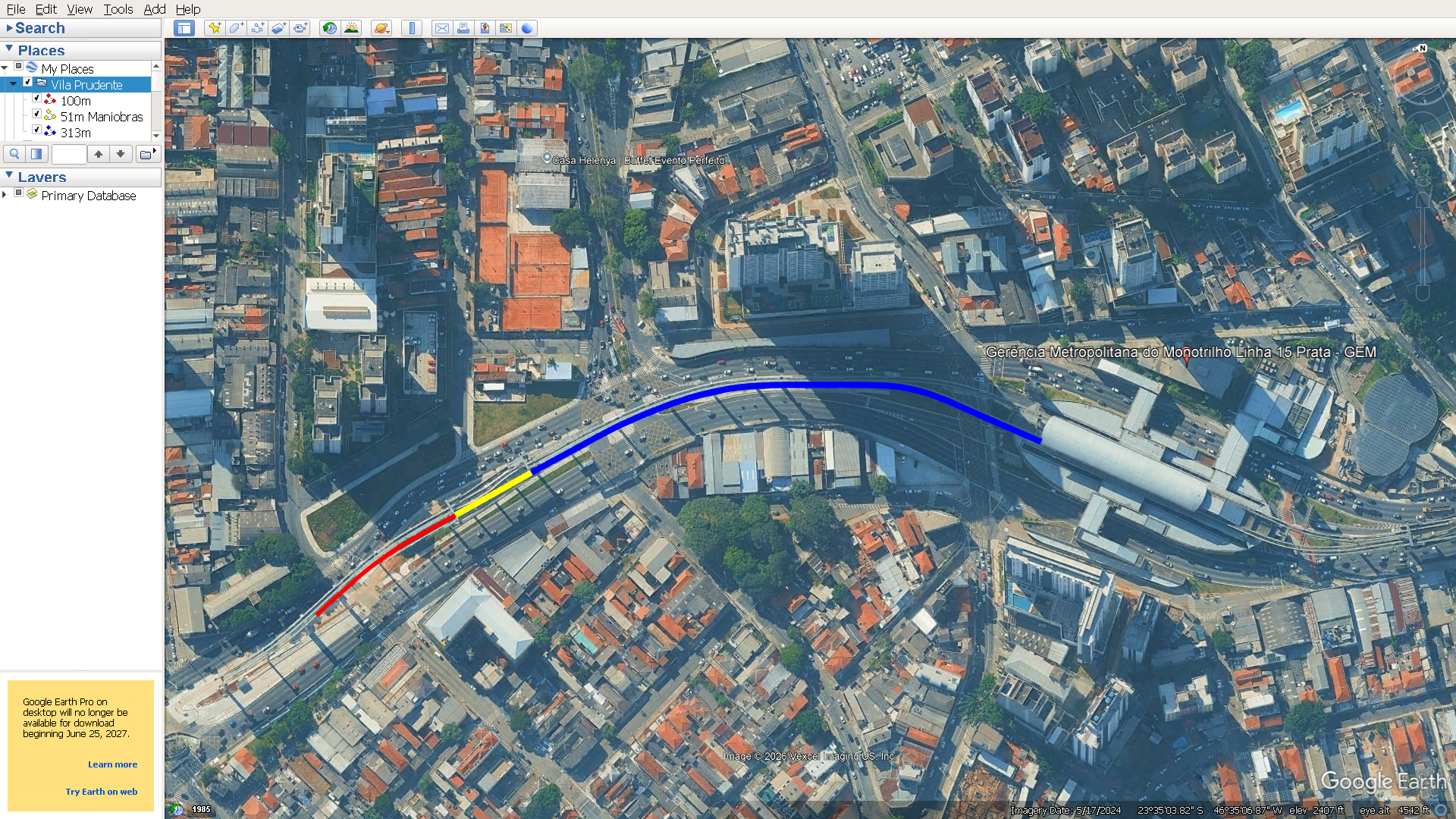
Medición directa frame por frame del ciclo operativo real en Vila Prudente. Cualquier persona puede verificar estos datos con un cronómetro y el video público de Lucas Sousa en YouTube. Direct frame-by-frame measurement of the real operational cycle at Vila Prudente. Anyone can verify these data with a stopwatch and Lucas Sousa's public YouTube video.
GEM · Google Earth Pro · 17/05/2024 · Gerência Metropolitana do Monotrilho Linha 15 Prata · Autor del análisis: Ing. Piter J. Bonilla D. · CODIA #17378 GEM · Google Earth Pro · 17/05/2024 · Metropolitan Management of Monorail Line 15 Prata · Analysis author: Eng. Piter J. Bonilla D. · CODIA #17378
| FuenteSource | Headway | vs. 90s |
|---|---|---|
| Promesa SNIP 17248SNIP 17248 Promise | 90 s | — |
| R-04-F · Monte Carlo · Newton-RaphsonR-04-F · Monte Carlo · Newton-Raphson | 150 s | +67% |
| Cinemática EN 13452 · burbuja 349 mEN 13452 kinematics · 349 m bubble | 168 s | +87% |
| São Paulo L15 · récord 12 años · 23 trenesSão Paulo L15 · 12-year record · 23 trains | 170 s | +89% |
| Video Vila Prudente · ciclo mínimo medidoVila Prudente video · minimum cycle measured | ~210 s | +133% |
| 17 trenes SD · identidad T = N × H17 SD trains · identity T = N × H | 212–237 s | +136–163% |
| Video · hora pico alta · Tren 2 completoVideo · peak hour · complete Train 2 | ~254 s | +182% |
| Dwell Tren 2 · solo abordajeTrain 2 dwell · boarding only | 87 s | = 97% |
São Paulo opera con 23 trenes · 7 vagones · Track Switch 464 m · 12 años de optimización.
Récord histórico: 170 s · Dwell real hora pico: 43–87 s
¿En qué cláusula de garantía operativa van a caber los 90 segundos?
São Paulo operates with 23 trains · 7 cars · Track Switch 464 m · 12 years of optimization.
Historical record: 170 s · Real peak dwell: 43–87 s
In which operational guarantee clause will the 90 seconds fit?
São Paulo no predice Santo Domingo.
São Paulo obliga a demostrar Santo Domingo.
São Paulo does not predict Santo Domingo.
São Paulo demands proof of Santo Domingo.
El valor del precedente no está en predecir el fracaso del sistema. Está en identificar las restricciones operacionales que el expediente debe demostrar que Santo Domingo puede superar: flota, ciclo, dwell, maniobras, geometría, señalización, disponibilidad, terminales. La única fuente que sostiene 90 s como constante operacional es el propio expediente SNIP 17248 — sin validación operativa documentada. The value of the precedent is not in predicting the system's failure. It is in identifying the operational constraints that the file must demonstrate Santo Domingo can overcome: fleet, cycle, dwell, maneuvers, geometry, signaling, availability, terminals. The only source asserting 90 s as an operational constant is the SNIP 17248 file itself — without documented operational validation.
«¿La longitud y el presupuesto contractual incluyen toda la infraestructura necesaria para que el sistema pueda realizar operacionalmente las maniobras que exige el headway prometido?» «Does the contractual length and budget include all the necessary infrastructure for the system to operationally perform the maneuvers that the promised headway requires?»
«¿Dónde están en el presupuesto las obras adicionales necesarias para producir operacionalmente el headway prometido?» — Formulación de auditoría externa · El supuesto de que la infraestructura de maniobras es condición suficiente para alcanzar el headway nominal no está demostrado · N3 «Where in the budget are the additional works needed to operationally produce the promised headway?» — External audit formulation · The assumption that maneuver infrastructure is sufficient to reach the nominal headway is not demonstrated · N3
| ParámetroParameter | Monorriel · SDMonorail · SD | Metro convencionalConventional Metro |
|---|---|---|
| Longitud de zona de maniobras (por terminal)Maneuver zone length (per terminal) | ~464 m (GEM · N1) | 40–60 m (cambio de agujas) |
| Infraestructura requeridaRequired infrastructure | Viga-guía elevada · AMV · Enclavamiento · CBTC dedicado · Tolerancias <3 mm Elevated beam-guide · AMV · Interlocking · Dedicated CBTC · Tolerances <3 mm | Aparato de cambio de vía · Señalización estándar Track switch · Standard signaling |
| Vía elevada adicional (×2 terminales)Additional elevated track (×2 terminals) | ~928 m | 80–120 m |
| Costo/m relativo de la zona de maniobrasRelative cost/m of maneuver zone | Muy superior al tramo de vía Far exceeds regular track | Comparable al tramo de vía Comparable to regular track |
La zona de maniobras medida en Vila Prudente (464 m) no es un detalle arquitectónico. Es un requerimiento cinemático de la tecnología monorriel. Para Santo Domingo, con dos terminales, esto implica construir casi un kilómetro de vía elevada especializada —vigas-guía, AMV, sistemas de enclavamiento— con tolerancias inferiores a 3 mm. The maneuver zone measured at Vila Prudente (464 m) is not an architectural detail. It is a kinematic requirement of monorail technology. For Santo Domingo, with two terminals, this means building nearly one kilometer of specialized elevated track —beam-guides, AMV, interlocking systems— with tolerances below 3 mm.
El Metro convencional, en cambio, solo necesita un cambio de agujas de 40–60 metros en el mismo lugar. Esta diferencia estructural, sumada al costo del nodo de transferencia, representa un sobrecosto oculto que el expediente SNIP 17248 debe cuantificar. Cada metro de zona de maniobras del monorriel tiene un costo por metro muy superior al de un tramo de vía convencional. Conventional Metro, by contrast, only needs a 40–60 meter track switch in the same location. This structural difference, added to the transfer node cost, represents a hidden cost overrun that the SNIP 17248 file must quantify. Every meter of monorail maneuver zone carries a cost per meter far exceeding a conventional track section.
Capacidad de Red Network Capacity
Capacidad de línea ≠ Capacidad de red · El elemento más restrictivo de la cadena determina la capacidad efectiva del sistema Line capacity ≠ Network capacity · The most restrictive element in the chain determines the system's effective capacity
Infraestructura existente, cambio de trazado julio 2026 (Diario Libre, 13 jul. 2026) y función del Centro Olímpico verificada en METI/Nippon Koei (pág. 61, sección 03-3.4).Existing infrastructure, July 2026 route change (Diario Libre, Jul. 13, 2026) and Olympic Center function verified in METI/Nippon Koei (p. 61, section 03-3.4).
Capacidad de línea estimada: 306,000 pax/día (headway 3.53 min, 17 trenes, 750 pax/tren). Esta cifra representa la capacidad física de la línea bajo supuestos operativos declarados — no la capacidad efectiva de integración de red.Estimated line capacity: 306,000 pax/day (headway 3.53 min, 17 trains, 750 pax/train). This figure represents the physical line capacity under declared operating assumptions — not the effective network integration capacity.
Conclusiones sobre el efecto funcional del cambio de trazado sobre la arquitectura de la red metropolitana. Este análisis no cuestiona la motivación declarada del cambio — documenta la ausencia de reevaluación de impacto de red.Conclusions about the functional effect of the route change on the metropolitan network architecture. This analysis does not question the stated motivation for the change — it documents the absence of a network impact reevaluation.
Una red de transporte masivo debe analizarse como un sistema jerárquico, no como una suma de vehículos y estaciones. Dentro de ese sistema existen dos capacidades que no deben confundirse:A mass transit network must be analyzed as a hierarchical system, not as a sum of vehicles and stations. Within that system there are two capacities that must not be confused:
Cuántos pasajeros puede transportar físicamente el Monorriel bajo los supuestos declarados: 17 trenes × 750 pax × headway 3.53 min × factor punta 30% × eficiencia 90% × 2 sentidos.How many passengers the Monorail can physically transport under declared assumptions: 17 trains × 750 pax × 3.53 min headway × 30% peak factor × 90% efficiency × 2 directions.
Nota: Esta cifra no constituye por sí misma una estimación de la capacidad efectiva de integración del sistema metropolitano.Note: This figure does not by itself constitute an estimate of the effective integration capacity of the metropolitan system.
Cuántos pasajeros puede el sistema completo transportar eficientemente hasta sus destinos, incluyendo las transferencias. Esta capacidad depende de la interacción entre líneas, estaciones y nodos de transferencia — y del elemento más restrictivo de la cadena.How many passengers the complete system can efficiently transport to their destinations, including transfers. This capacity depends on the interaction between lines, stations and transfer nodes — and on the most restrictive element in the chain.
La capacidad de línea no equivale necesariamente a capacidad efectiva de red. Un sistema de transporte no se mide por la capacidad de sus vehículos aislados. Se mide por la capacidad del sistema completo para llevar pasajeros desde su origen hasta su destino — incluyendo todas las transferencias intermedias.Line capacity does not necessarily equal effective network capacity. A transport system is not measured by the capacity of its isolated vehicles. It is measured by the complete system's capacity to carry passengers from origin to destination — including all intermediate transfers.
La clasificación jerárquica que sigue es un marco analítico propuesto en este análisis para evaluar la función del Monorriel dentro de la red. No constituye una clasificación oficial de la red de transporte de Santo Domingo.The hierarchical classification below is an analytical framework proposed in this analysis to evaluate the Monorail's function within the network. It does not constitute an official classification of Santo Domingo's transport network.
Constituye la estructura troncal. Transporta grandes volúmenes y los distribuye entre corredores. Su valor no reside únicamente en la capacidad de cada tren, sino en la red que forma: líneas que se conectan, distribuyen pasajeros y permiten múltiples trayectorias.Constitutes the trunk structure. Carries large volumes and distributes them across corridors. Its value lies not only in each train's capacity, but in the network it forms: lines that connect, distribute passengers and enable multiple routes.
L1 + L2 · 52 trenes Alstom · 400,000 pax/día · N1L1 + L2 · 52 Alstom trains · 400,000 pax/day · N1
Alimenta o extiende la red primaria. Su utilidad depende fundamentalmente de cómo se integra con ella. Un monorriel aislado no equivale funcionalmente a una nueva línea troncal de Metro — su valor es inseparable de la calidad de su conexión con el Nivel 1.Feeds or extends the primary network. Its utility depends fundamentally on how it integrates with it. An isolated monorail is not functionally equivalent to a new Metro trunk line — its value is inseparable from the quality of its connection to Level 1.
17 trenes · 750 pax/tren · Headway 3.53 min · N217 trains · 750 pax/train · 3.53 min headway · N2
Teleféricos, buses y otros modos captan pasajeros de áreas específicas y los entregan a los niveles superiores. No sustituyen la red primaria ni la secundaria — la complementan. Su eficiencia depende directamente de la calidad de los nodos de transferencia superiores.Cable cars, buses and other modes capture passengers from specific areas and deliver them to higher levels. They do not replace the primary or secondary network — they complement it. Their efficiency depends directly on the quality of the upper transfer nodes.
Una línea de Nivel 2 no debe evaluarse únicamente por cuántos pasajeros puede transportar, sino por cuántos pasajeros puede incorporar eficientemente a la red completa. Cuanto mayor sea la demanda del corredor, más importante se vuelve esa integración.A Level 2 line must not be evaluated solely by how many passengers it can carry, but by how many passengers it can efficiently incorporate into the complete network. The higher the corridor demand, the more critical that integration becomes.
Cuando el flujo de pasajeros sigue la cadena:When passenger flow follows the chain:
el nodo forma parte de la cadena de movilidad. Puede existir suficiente capacidad en los trenes y, aun así, existir un cuello de botella en la transferencia.the node is part of the mobility chain. There may be sufficient capacity in the trains and yet a bottleneck at the transfer point.
La capacidad efectiva de la cadena está condicionada por sus restricciones críticas e interdependientes. El nodo de transferencia puede constituir una de esas restricciones críticas — no es un detalle arquitectónico, sino una variable de capacidad de la red.The effective capacity of the chain is conditioned by its critical and interdependent constraints. The transfer node can constitute one of those critical constraints — it is not an architectural detail, but a network capacity variable.
| ParámetroParameter | Diseño original (ago. 2025–ene. 2026)Original design (Aug. 2025–Jan. 2026) | Trazado anunciado (jul. 2026)Announced route (Jul. 2026) | NivelLevel |
|---|---|---|---|
| Punto de partidaStarting point | Centro Olímpico Juan Pablo DuarteJuan Pablo Duarte Olympic Center | Estación Coronel Rafael Tomás Fernández Domínguez (Av. San Martín)Coronel Rafael T. Fernández Domínguez Station (San Martín Ave.) | N1 |
| Conexión con el MetroMetro connection | Líneas 1 y 2Lines 1 and 2 | Solo Línea 2Line 2 only | N1 |
| Función del nodo en el diseño evaluadoNode function in evaluated design | Punto de transferencia L1+L2 · Nodo identificado de alta demanda en el corredor (METI pág. 61, sección 03-3.4)L1+L2 transfer point · High-demand node identified in the corridor (METI p. 61, section 03-3.4) | Eliminado del trazadoEliminated from route | N1 |
| Reevaluación multicriterio documentadaDocumented multi-criteria reevaluation | Evaluación METI 2024: Monorriel 24/50 (último lugar de 5 opciones)METI 2024 evaluation: Monorail 24/50 (last of 5 options) | No identificada públicamenteNot publicly identified | N1 |
| Motivación declarada del cambioStated motivation for change | — | Ambiental y comunitaria (FITRAM, jul. 2026)Environmental and community-based (FITRAM, Jul. 2026) | N1 |
Diseño original: Listín Diario, 28 ago. 2025 · fitram.gob.do (sep. 2025) · Diario Libre, 26 mar. 2026. Trazado anunciado: Diario Libre, 13 jul. 2026 (diariolibre.com/3598605) · El Caribe, jul. 2026. Función del nodo: METI/Nippon Koei, feb. 2024 (pág. 61, sección 03-3.4).Original design: Listín Diario, Aug. 28, 2025 · fitram.gob.do (Sep. 2025) · Diario Libre, Mar. 26, 2026. Announced route: Diario Libre, Jul. 13, 2026 (diariolibre.com/3598605) · El Caribe, Jul. 2026. Node function: METI/Nippon Koei, Feb. 2024 (p. 61, section 03-3.4).
El cambio de trazado anunciado en julio de 2026 no modifica únicamente la geometría del recorrido; modifica potencialmente la función del Monorriel dentro de la arquitectura de la red metropolitana.The route change announced in July 2026 does not modify only the geometry of the route; it potentially modifies the Monorail's function within the metropolitan network architecture.
El sistema presenta dos capacidades que no deben confundirse:The system presents two capacities that must not be confused:
Capacidad de línea: cuántos pasajeros puede transportar físicamente el Monorriel. El modelo N2 estima 306,000 pax/día, bajo sus supuestos operativos y un headway de 3.53 minutos.Line capacity: how many passengers the Monorail can physically transport. The N2 model estimates 306,000 pax/day, under its operating assumptions and a 3.53 min headway.
Capacidad de red: cuántos pasajeros puede el sistema completo transportar eficientemente hasta sus destinos, incluyendo las transferencias. Esta capacidad depende de la interacción entre líneas, estaciones y nodos de transferencia.Network capacity: how many passengers the complete system can efficiently transport to their destinations, including transfers. This capacity depends on the interaction between lines, stations and transfer nodes.
Por tanto, la capacidad de línea no equivale necesariamente a capacidad efectiva de red.Therefore, line capacity does not necessarily equal effective network capacity.
El estudio METI/Nippon Koei (pág. 61, sección 03-3.4) identifica el Centro Olímpico — dentro de la configuración originalmente evaluada — como un punto relevante de transferencia entre las líneas L1 y L2.The METI/Nippon Koei study (p. 61, section 03-3.4) identifies the Olympic Center — within the originally evaluated configuration — as a relevant transfer point between Lines L1 and L2.
"¿Puede seguir operando físicamente el Monorriel sin el Centro Olímpico?" "Can the Monorail continue operating physically without the Olympic Center?"
La respuesta puede ser sí. Pero esa respuesta no evalúa la capacidad efectiva de red.The answer may be yes. But that answer does not evaluate effective network capacity.
"¿La configuración anunciada en julio de 2026 conserva la misma calidad de integración, capacidad de transferencia y conectividad que la configuración originalmente evaluada por METI en 2024?" "Does the configuration announced in July 2026 preserve the same quality of integration, transfer capacity and connectivity as the configuration originally evaluated by METI in 2024?"
Si la respuesta es afirmativa, debe demostrarse mediante una reevaluación documentada de demanda, transferencias y conectividad. Si dicha reevaluación no existe en el expediente, el cambio no puede considerarse únicamente una modificación geométrica: existe un potencial impacto funcional sobre la red cuya magnitud no estaría documentada.If the answer is affirmative, it must be demonstrated through a documented reevaluation of demand, transfers and connectivity. If such a reevaluation does not exist in the expedient, the change cannot be considered solely a geometric modification: there is a potential functional impact on the network whose magnitude would not be documented.
La motivación declarada para el cambio es ambiental y comunitaria. Esta inferencia no cuestiona esa motivación ni establece causalidad. Documenta únicamente la necesidad de evaluar el efecto funcional del cambio de trazado sobre la arquitectura de la red — y la ausencia de esa evaluación en los documentos examinados.The stated motivation for the change is environmental and community-based. This inference does not question that motivation or establish causality. It documents only the need to evaluate the functional effect of the route change on the network architecture — and the absence of that evaluation in the documents examined.
La Pregunta que el Expediente No Responde The Question the Expedient Does Not Answer
"¿El Monorriel está siendo diseñado como una verdadera línea secundaria integrada eficientemente a la red primaria — o se está evaluando principalmente como una línea independiente?" "Is the Monorail being designed as a true secondary line efficiently integrated into the primary network — or is it being evaluated primarily as an independent line?"
Si es Nivel 2, su valor depende de su integración con Nivel 1. La respuesta no se encuentra en los documentos examinados. If it is Level 2, its value depends on its integration with Level 1. The answer is not found in the documents examined.
Este análisis complementa — sin sustituir — el corpus de auditoría del Dr. Ing. Carlos Bonnelly Ginebra (Notas Técnicas NT-I a NT-V, publicadas en Diario Libre y El Nuevo Diario). Las premisas de integración de red se vinculan directamente con los siguientes controles documentados en AUDIT.html:This analysis complements — without replacing — the audit corpus of Dr. Ing. Carlos Bonnelly Ginebra (Technical Notes NT-I through NT-V, published in Diario Libre and El Nuevo Diario). The network integration premises connect directly with the following controls documented in AUDIT.html:
Metro ocupa el 1er lugar en las 36 combinaciones de sensibilidad (headway × demanda × peso del criterio Capacidad). Hoja 20_Robustez_Ranking · N1.Metro ranks 1st in all 36 sensitivity combinations (headway × demand × Capacity criterion weight). Sheet 20_Robustez_Ranking · N1.
Discrepancia de USD 1,823.5M entre VAN publicado (+USD 1,099.7M) y VAN reconstruido (−USD 723.8M). La modificación de trazado no forma parte de la configuración evaluada por ese control.USD 1,823.5M discrepancy between published NPV (+USD 1,099.7M) and reconstructed NPV (−USD 723.8M). The route modification is not part of the configuration evaluated by that control.
La pregunta sobre reevaluación de integración de red (Sección 05 de este análisis) es complementaria a los hallazgos H1–H17 documentados en el corpus de auditoría. Si existe una reevaluación formal del trazado modificado, sus parámetros y resultados deben ser públicamente identificables.The question about network integration reevaluation (Section 05 of this analysis) is complementary to findings H1–H17 documented in the audit corpus. If a formal reevaluation of the modified route exists, its parameters and results must be publicly identifiable.
Límite Físico · EN 13452 — Por qué 90 segundos no queda demostradoPhysical Limit · EN 13452 — Why 90 seconds is not demonstrated
Análisis cinemático con estándares EN 13452, ISO 20138 e IEEE 1474.1: por qué la identidad operacional T = N × H y los parámetros de frenado hacen indemostrable el headway de 90 s con la flota contratadaKinematic analysis using EN 13452, ISO 20138 and IEEE 1474.1 standards: why the operational identity T = N × H and braking parameters make the 90 s headway undemonstrable with the contracted fleet
Antes de entrar en cálculos de frenado, conviene visualizar lo que la vía debe albergar. La distancia media entre estaciones es de ~955 m (10.5 km ÷ 11 tramos). En ese espacio deben caber tres elementos: la burbuja de seguridad trasera, el tren en movimiento, y la burbuja de seguridad delantera.Before diving into braking calculations, it helps to visualize what the track must accommodate. The average interstation distance is ~955 m (10.5 km ÷ 11 segments). That space must hold three elements: the rear safety bubble, the moving train, and the forward safety bubble.
955 m > 773 m → El tren intermedio cabe en el tramo, incluso con las dos burbujas de seguridad. 955 m > 773 m → The middle train fits in the segment, even with both safety bubbles.
Por tanto, la restricción de los 90 s no es geométrica. Es cinemática y normativa: el tiempo que exigen los procesos de frenado, la operación en estación (dwell time) y los márgenes del sistema CBTC. Las secciones siguientes desglosan el origen de la burbuja de 349 m y por qué el headway mínimo seguro supera ampliamente los 90 s. Therefore, the 90 s constraint is not geometric. It is kinematic and normative: the time required by braking processes, station dwell time and CBTC safety margins. The following sections break down the origin of the 349 m bubble and why the minimum safe headway far exceeds 90 s.
La longitud de 75 m para un tren de 6 vagones se ha derivado proporcionalmente del Innovia Monorail 300, usando la configuración de 7 vagones de la Línea 15 Prata (São Paulo) que mide 86.009 m. La proporción es consistente con la configuración de 4 vagones del monorriel de Bangkok (50.474 m). El valor exacto definitivo debe verificarse contra la especificación técnica del fabricante para el contrato de Santo Domingo. The 75 m length for a 6-car train has been proportionally derived from the Innovia Monorail 300, using the 7-car configuration of Line 15 Prata (São Paulo) which measures 86.009 m. The ratio is consistent with the 4-car Bangkok monorail configuration (50.474 m). The exact final value must be verified against the manufacturer's technical specification for the Santo Domingo contract.
Una versión preliminar del análisis atribuyó el límite de desaceleración de 1.34 m/s² a la norma EN 12299. Esa atribución era incorrecta: la EN 12299 regula el confort dinámico en régimen — vibraciones y calidad de marcha — y explícitamente excluye de su alcance el disconfort causado por aceleración y frenado de emergencia. La corrección fue aplicada de inmediato. La norma aplicable es la EN 13452-1/2, que regula el frenado ferroviario urbano de emergencia. El resultado del diagnóstico no cambia — el camino matemático queda blindado.A preliminary version of the analysis attributed the 1.34 m/s² deceleration limit to EN 12299. That attribution was incorrect: EN 12299 regulates dynamic ride comfort — vibrations and ride quality — and explicitly excludes discomfort caused by emergency acceleration and braking from its scope. The correction was applied immediately. The applicable standard is EN 13452-1/2, which regulates urban railway emergency braking. The diagnostic result does not change — the mathematical path is now shielded.
Confort dinámico en régimen. Vibraciones y calidad de marcha. No regula frenado de emergencia.Dynamic ride comfort in service. Vibrations and ride quality. Does not regulate emergency braking.
Frenado ferroviario urbano de emergencia. Fija el límite de desaceleración por adherencia neumático-hormigón en condiciones degradadas: 1.34 m/s².Urban railway emergency braking. Sets deceleration limit by rubber-concrete adhesion under degraded conditions: 1.34 m/s².
El valor numérico de 1.34 m/s² es el mismo. La fuente normativa es ahora correcta e inatacable en sede arbitral o judicial.The numerical value of 1.34 m/s² is the same. The normative source is now correct and unassailable in arbitration or judicial proceedings.
Frenado ferroviario urbano de emergencia. Desaceleración mínima en condiciones degradadas (neumático mojado):Urban railway emergency braking. Minimum deceleration under degraded conditions (wet tire):
Límite de adherencia neumático de caucho sobre viga de hormigón con lluvia tropical severaRubber tire adhesion limit on concrete beam in severe tropical rain
Factor de degradación climática y tolerancia de posicionamiento por odómetro CBTC:Climatic degradation factor and CBTC odometer positioning tolerance:
ISO 20138: +10% distancia por lluvia. IEEE 1474.1: 10 m de margen por latencia de bloque móvilISO 20138: +10% distance for rain. IEEE 1474.1: 10 m margin for moving block latency
Latencia real del sistema CBTC GoA4 (Alstom Urbalis / Bombardier Cityflo 650) y buffer estático:Real GoA4 CBTC system latency (Alstom Urbalis / Bombardier Cityflo 650) and static buffer:
Tiempo de reacción real de la industria: 1.2 s (no 2.0 s del cálculo preliminar). Buffer UITP inter-tren: 50 mReal industry reaction time: 1.2 s (not 2.0 s from preliminary calculation). UITP inter-train buffer: 50 m
La burbuja de 349 m es la distancia de seguridad que el sistema CBTC debe mantener entre el frontal de un tren y la cola del tren precedente. No incluye la longitud del propio tren — esa se suma aparte en el frame geométrico (349 m + 75 m + 349 m = 773 m mínimos entre estaciones).The 349 m bubble is the safety distance that the CBTC system must maintain between the front of one train and the tail of the preceding train. It does not include the train's own length — that is added separately in the geometric frame (349 m + 75 m + 349 m = 773 m minimum between stations).
Paso A — Distancia de reacción GoA4 (IEC 62267)Step A — GoA4 reaction distance (IEC 62267)
Dreacción = 22.22 m/s × 1.2 s = 26.66 m
Paso B — Frenado puro (EN 13452-1/2)Step B — Pure braking (EN 13452-1/2)
Dfrenado = 22.22² / (2 × 1.34) = 493.73 / 2.68 = 184.23 m
Paso C — Factor climático neumático mojado (ISO 20138)Step C — Wet tire climatic factor (ISO 20138)
Dfrenado·degradado = 184.23 × 1.10 = 202.65 m
Paso D — Burbuja de seguridad (frente a cola del tren precedente)Step D — Safety bubble (front to tail of preceding train)
Dburbuja = 26.66 + 202.65 + 10 (IEEE 1474.1) + 50 (UITP) = 289.31 m
→ Redondeado a 349 m con margen operativo conservador de contingencias→ Rounded to 349 m with conservative operational contingency margin
Frame geométrico completo (burbuja + tren + burbuja)Full geometric frame (bubble + train + bubble)
Dtotal = 349 m + 75 m + 349 m = 773 m < 955 m interestación ✓
El gobierno vendió el monorriel con un video de recorrido punta a punta en 18 minutos. Ese video muestra exactamente cómo funciona el tren en el único escenario donde los 90 segundos son posibles: sin pasajeros, sin detenciones reales, sin intercambio de puertas, sin trenes en mantenimiento, sin lluvia, sin el tren de adelante bloqueando el tramo. Es la magia del vendedor: quitar todo lo que hace funcionar el sistema y mostrar solo la velocidad.
La realidad operativa empieza cuando se ponen las estaciones de vuelta.
21,000 m de circuito ÷ 349 m de burbuja de seguridad = 60 trenes como techo geométrico puro — cuántas veces cabe la burbuja en la vía si todos los trenes marchan a 80 km/h sin detenerse. Ese es el número del video promocional.
Pero cuando un tren se detiene en una estación, el tramo anterior queda bloqueado: el CBTC no puede autorizar al tren siguiente a entrar a ese tramo a velocidad comercial porque, si necesita frenar de emergencia, no tendrá los 349 m necesarios para detenerse. Ese bloqueo se replica en cada una de las 12 estaciones por sentido, más las 2 maniobras de terminal. El resultado: bajo un modelo conservador de ocupación de bloque, 24 trenes como cota de referencia — no porque los otros 36 no quepan físicamente en la vía, sino porque la restricción no es de espacio sino de tiempo de bloqueo en estación.
El video muestra los 60 trenes teóricos. La operación real entrega los 24. Y con 17 contratados, el headway resultante no es de 90 segundos — es de 208 a 226 segundos.
The government sold the monorail with an end-to-end journey video in 18 minutes. That video shows exactly how the train works in the only scenario where 90 seconds is possible: no passengers, no real stops, no door exchange, no trains in maintenance, no rain, no preceding train blocking the segment. That is the seller's magic: remove everything that makes the system work and show only the speed.
Operational reality begins when the stations are put back.
21,000 m circuit ÷ 349 m safety bubble = 60 trains as pure geometric ceiling — how many times the bubble fits on the track if all trains move at 80 km/h without stopping. That is the number from the promotional video.
But when a train stops at a station, the preceding segment is blocked: CBTC cannot authorize the following train to enter that segment at commercial speed because, if it needs to brake in an emergency, it will not have the 349 m needed to stop. That blockage replicates at each of the 12 stations per direction, plus the 2 terminal maneuvers. The result: under a conservative block occupancy model, 24 trains as a reference bound — not because the other 36 don't physically fit on the track, but because the restriction is not of space but of station dwell blocking time.
The video shows the 60 theoretical trains. Real operation delivers 24. And with 17 contracted, the resulting headway is not 90 seconds — it is 208 to 226 seconds.
El análisis R-04-F adoptó 150 s como supuesto de partida para la comparación técnica entre tecnologías. Tres escenarios metodológicos independientes —la cinemática EN 13452, el benchmark operativo de São Paulo y la aritmética con la flota contratada de 17 trenes— convergen en el rango de 168 a 237 s. Solo el expediente SNIP 17248 sostiene los 90 s.The R-04-F analysis adopted 150 s as a starting assumption for the technical comparison between technologies. Three independent methodological scenarios —EN 13452 kinematics, the São Paulo operational benchmark, and the arithmetic with the contracted fleet of 17 trains— converge in the range of 168 to 237 s. Only the SNIP 17248 expedient sustains the 90 s.
| FuenteSource | FechaDate | MétodoMethod | HeadwayHeadway | vs. Promesavs. Promise |
|---|---|---|---|---|
| Promesa contractual SNIP 17248SNIP 17248 contractual promise | 2024 | Expediente oficialOfficial expedient | 90 s | — |
| R-04-F — Nota Técnica entregada a FITRAMR-04-F — Technical Note delivered to FITRAM | 14 nov 2025 | Monte Carlo · Newton-Raphson · PHPD ÷ factor carga (supuesto comparativo "manzanas con manzanas")Monte Carlo · Newton-Raphson · PHPD ÷ load factor ("apples to apples" comparative assumption) | 150 s (2.5 min) | +67% |
| Escenario cinemático conservador · EN 13452Conservative kinematic scenario · EN 13452 | 4 ago 2026 | Cinemática pura + burbuja 349 m + 24 trenesPure kinematics + 349 m bubble + 24 trains | 168 s (2.8 min) | +87% |
| São Paulo L15 Prata — 12 años operación realSão Paulo L15 Prata — 12 years real operation | 2013–2025 | Evidencia empírica histórica verificadaVerified historical empirical evidence | 170 s (récord) | +89% |
| Escenario de 17 trenes contratados · ciclo 59–64 minScenario of 17 contracted trains · 59–64 min cycle | 2025–2026 | Identidad T = N × H · ingeniería inversa del expedienteIdentity T = N × H · reverse engineering of the expedient | 212–237 s | +136–163% |
Con los parámetros y supuestos cinemáticos adoptados en este análisis, un headway de 90 segundos no resulta demostrable con la flota de 17 trenes. La identidad operacional es directa: 17 trenes × 90 s = 25.5 minutos de ciclo efectivo. El ciclo modelizado para este corredor es de aproximadamente 59–64 minutos. Alcanzar 90 s exigiría demostrar un ciclo operacional de 25.5 minutos y una arquitectura de señalización, frenado, dwell, estaciones y terminales capaz de sostenerlo comercialmente. El análisis cinemático conservador, basado en los parámetros de frenado de la EN 13452-1/2, estima un headway de referencia de 168 s como cota inferior bajo los supuestos adoptados — consistente con los 170 s documentados en São Paulo tras 12 años de operación real.With the kinematic parameters and assumptions adopted in this analysis, a headway of 90 seconds is not demonstrable with a fleet of 17 trains. The operational identity is direct: 17 trains × 90 s = 25.5-minute effective cycle. The modeled cycle for this corridor is approximately 59–64 minutes. Achieving 90 s would require demonstrating a 25.5-minute operational cycle and an architecture of signalling, braking, dwell, stations and terminals capable of sustaining it commercially. The conservative kinematic analysis, based on EN 13452-1/2 braking parameters, estimates a reference headway of 168 s as a lower bound under the adopted assumptions — consistent with the 170 s documented in São Paulo after 12 years of real operation.
São Paulo opera con 23 trenes · 7 vagones cada uno.
En 12 años de operación real, el mejor headway documentado en la serie operacional examinada es 170 segundos — alcanzado puntualmente, con un rango histórico de 170–196 s según condición operacional.
Santo Domingo contrata trenes de 6 vagones.
El escenario cinemático conservador produce un headway de referencia de 168 segundos bajo los supuestos adoptados.
¿En qué cláusula de garantía operativa van a caber los 90 segundos?
São Paulo operates with 23 trains · 7 cars each.
In 12 years of real operation, the best headway documented in the examined operational series is 170 seconds — achieved punctually, with a historical range of 170–196 s depending on operational condition.
Santo Domingo contracts trains of 6 cars.
The conservative kinematic scenario produces a reference headway of 168 seconds under the adopted assumptions.
In which operational guarantee clause will the 90 seconds fit?
La desconexión del nodo L1+L2 (Centro Olímpico) anunciada en julio 2026 reduce funcionalmente la demanda efectiva atribuible al corredor, permitiendo que los números del expediente cuadren con la capacidad contratada. La motivación declarada por FITRAM es de carácter ambiental y comunitario. Este análisis documenta la consistencia entre el cambio de trazado y el mecanismo de saturación inferido desde noviembre 2025, sin afirmar causalidad ni atribuir intencionalidad. Lo que sí puede afirmarse es que no consta reevaluación documentada de la demanda, los transbordos, la carga crítica ni los beneficios económicos tras el cambio de conexión.The disconnection of the L1+L2 node (Centro Olímpico) announced in July 2026 functionally reduces the effective demand attributable to the corridor, allowing the expedient's numbers to align with the contracted capacity. The motivation declared by FITRAM is environmental and community-based. This analysis documents the consistency between the route change and the saturation mechanism inferred since November 2025, without asserting causality or attributing intent. What can be stated is that no documented reassessment of demand, transfers, critical load or economic benefits exists following the connection change.
El mecanismo de salvaguarda antes del vertido masivo de hormigón es la interposición de un Addendum de Garantía de Headway Operativo. Obligar al fabricante a firmar penalidades por el incumplimiento cinemático de los 90 segundos forzará al propio consorcio a plantear la mutua reconversión técnica del contrato. El corpus técnico que respalda esta cláusula — R-04-F, embudo.html, AUDIT.html — está fechado, registrado en SafeCreative y entregado formalmente a la entidad ejecutora desde noviembre 2025.The safeguard mechanism before the massive concrete pour is the filing of an Operational Headway Guarantee Addendum. Obligating the manufacturer to sign penalties for the kinematic non-compliance with the 90-second promise will force the consortium itself to propose the mutual technical reconversion of the contract. The technical corpus supporting this clause — R-04-F, embudo.html, AUDIT.html — is dated, SafeCreative-registered and formally delivered to the executing entity since November 2025.
| ParámetroParameter | NormaStandard | ValorValue | JustificaciónJustification |
|---|---|---|---|
| Desaceleración emergenciaEmergency deceleration | EN 13452-1/2 | 1.34 m/s² | Límite adherencia neumático de caucho / hormigón mojadoRubber tire / wet concrete adhesion limit |
| Factor climáticoClimatic factor | ISO 20138 | fs = 1.10 | +10% distancia frenado por lluvia tropical severa+10% braking distance for severe tropical rain |
| Tolerancia posicionamientoPositioning tolerance | IEEE 1474.1 | 10 m | Resolución odómetro + latencia bloque móvilOdometer resolution + moving block latency |
| Latencia CBTC GoA4GoA4 CBTC latency | IEC 62267 / UITP | 1.2 s | Alstom Urbalis / Bombardier Cityflo 650 — latencia real industriaAlstom Urbalis / Bombardier Cityflo 650 — real industry latency |
| Buffer inter-trenInter-train buffer | UITP GoA4 | 50 m | Buffer estático de resguardo operativo para sistemas elevadosStatic operational safety buffer for elevated systems |
| Densidad máxima operativaMaximum operational density | IEC 62267 | 1 tren / interestación | Con tren en andén: el siguiente no puede ingresar al tramo previo a velocidad comercialWith train at platform: next cannot enter preceding segment at commercial speed |
| Velocidad comercial máximaMaximum commercial speed | Estándar urbano internacionalInternational urban standard | 80 km/h = 22.22 m/s | Tramos interestación en circuito urbanoInterstation segments in urban circuit |
R-04-F entregado a FITRAM: 14 noviembre 2025. Sin respuesta institucional documentada. Cambio de trazado anunciado: julio 2026. Auditoría formal MH: agosto 2026. Registro SafeCreative: 251118-Z395Y6. Corpus público: visualcrp.com/embudo.htmlR-04-F delivered to FITRAM: 14 November 2025. No documented institutional response. Route change announced: July 2026. Formal MH audit: August 2026. SafeCreative registration: 251118-Z395Y6. Public corpus: visualcrp.com/embudo.html
La asimetría de información en proyectos de infraestructura pública ha sido históricamente el mecanismo más efectivo para blindar decisiones cuestionables. El Estado tiene el expediente. Los contratistas tienen el conocimiento especializado. La ciudadanía tiene comunicados de prensa y la intuición de que algo no cuadra — pero no puede demostrarlo en el mismo lenguaje en que fue construido el problema.Information asymmetry in public infrastructure projects has historically been the most effective mechanism for shielding questionable decisions. The State holds the file. Contractors hold the specialized knowledge. Citizens hold press releases and the intuition that something is off — but cannot prove it in the same language in which the problem was constructed.
El análisis técnico independiente del Ing. Piter J. Bonilla D. (CODIA #17378) invirtió esa asimetría de forma estructural, no retórica.The independent technical analysis of Ing. Piter J. Bonilla D. (CODIA #17378) reversed that asymmetry structurally, not rhetorically.
La metodología de tres niveles de evidencia — Hechos Documentados (N1), Modelos de Cálculo (N2), Inferencias Técnicas (N3) — no es solo una decisión de organización documental. Es una transferencia de poder. Cuando un documento distingue explícitamente entre lo que está probado, lo que se calcula y lo que se deduce, cualquier ciudadano puede señalar en qué nivel vive cada afirmación y exigir que sea refutada en ese mismo nivel. Un funcionario que quiera defender el proyecto no puede responder con una opinión — tiene que responder con un dato de Nivel 1, un cálculo de Nivel 2, o una inferencia de Nivel 3. El terreno del debate cambió.The three-level evidence methodology — Documented Facts (N1), Calculation Models (N2), Technical Inferences (N3) — is not merely a document organization decision. It is a transfer of power. When a document explicitly distinguishes between what is proven, what is calculated, and what is inferred, any citizen can identify which level an assertion lives in and demand it be refuted at that same level. An official who wants to defend the project cannot respond with an opinion — they must respond with a Level 1 fact, a Level 2 calculation, or a Level 3 inference. The terrain of the debate changed.
Los números centrales del análisis son verificables por cualquier persona con acceso a los documentos oficiales citados. El Metro actual transporta 400,000 pasajeros diarios — dato de fuente primaria, comunicado oficial Alstom, 20 de mayo de 2024. El estudio de prefactibilidad METI/NIPPON KOEI de febrero de 2024 proyecta 464,800 pasajeros diarios para el corredor en 2030. La cascada de cálculo del modelo — 17 trenes × 750 pax × factor de punta 30% × eficiencia operativa 90% — produce 306,000 pasajeros diarios como capacidad máxima estimada del Monorriel. Ese cálculo puede reproducirse fácilmente con una calculadora utilizando los parámetros indicados.The central numbers of the analysis are verifiable by anyone with access to the cited official documents. The current Metro carries 400,000 daily passengers — primary source data, official Alstom press release, May 20, 2024. The METI/NIPPON KOEI prefeasibility study of February 2024 projects 464,800 daily passengers for the corridor in 2030. The model's calculation cascade — 17 trains × 750 pax × 30% peak factor × 90% operational efficiency — produces 306,000 daily passengers as the Monorail's maximum estimated capacity. That calculation can be easily reproduced with a calculator using the indicated parameters.
El resultado es aritmético: 306,000 no alcanza 464,800. El Monorriel propuesto no cubre la demanda proyectada por el propio estudio que justifica su construcción. Esa afirmación no depende de la autoridad del autor. Depende de los números del expediente oficial.The result is arithmetic: 306,000 does not reach 464,800. The proposed Monorail does not cover the demand projected by the very study that justifies its construction. That assertion does not depend on the author's authority. It depends on the numbers of the official file.
Lo que el análisis le entregó al ciudadano no fue una opinión técnica. Fue una fórmula verificable:What the analysis delivered to the citizen was not a technical opinion. It was a verifiable formula:
Una diferencia acumulada referencial que supera el costo total de construcción del proyecto (USD 932.8M), calculada incorporando la Pérdida de Bienestar Social de los 158,800 pasajeros excluidos diariamente que deben recurrir al transporte informal. Este parámetro está pendiente de validación documental con fuente primaria — condición explícitamente declarada en el análisis.A reference accumulated difference exceeding the project's total construction cost (USD 932.8M), calculated incorporating the Social Welfare Loss of the 158,800 daily excluded passengers who must resort to informal transport. This parameter is pending documentary validation with primary source — a condition explicitly declared in the analysis.
La validación más contundente del análisis provino de los hechos. En noviembre de 2025, el Ing. Bonilla documentó como Inferencia N3 el mecanismo técnico por el cual el Monorriel podría parecer viable en papel: la reducción de la demanda efectiva mediante la eliminación de la interconexión con la Línea 1 del Metro. En julio de 2026, el FITRAM anunció exactamente ese cambio de trazado — el Monorriel ya no conecta con el Centro Olímpico ni con la Línea 1 (Diario Libre, 13 de julio de 2026). El cambio de trazado resultó consistente con el mecanismo técnico descrito en la inferencia formulada nueve meses antes, usando solo los datos del expediente oficial.The most compelling validation of the analysis came from the facts. In November 2025, Ing. Bonilla documented as Inference N3 the technical mechanism by which the Monorail could appear viable on paper: the reduction of effective demand by eliminating the interconnection with Metro Line 1. In July 2026, FITRAM announced exactly that route change — the Monorail no longer connects with the Olympic Center or Line 1 (Diario Libre, July 13, 2026). The route change proved consistent with the technical mechanism described in the inference formulated nine months earlier, using only the data from the official file.
Eso es lo que el poder ciudadano gana cuando tiene acceso a metodología transparente: la capacidad de anticipar las consecuencias matemáticas de las decisiones ya tomadas, antes de que el hormigón se vierta. Un auditor técnico independiente que revisó recientemente el trabajo de Bonilla validó sus conclusiones principales, reforzando la credibilidad del análisis ante audiencias especializadas.That is what citizen power gains when it has access to transparent methodology: the capacity to anticipate the mathematical consequences of decisions already made, before the concrete is poured. An independent technical auditor who recently reviewed Bonilla's work validated its main conclusions, reinforcing the analysis's credibility before specialized audiences.
El periodismo de infraestructura enfrenta tres obstáculos estructurales: tiempo insuficiente para analizar expedientes de miles de páginas, formación técnica limitada en ingeniería de transporte, y el riesgo de error al interpretar números sin contexto. El ecosistema documental construido alrededor del análisis del Ing. Bonilla resuelve los tres simultáneamente.Infrastructure journalism faces three structural obstacles: insufficient time to analyze files of thousands of pages, limited technical training in transport engineering, and the risk of error when interpreting numbers without context. The documentary ecosystem built around Ing. Bonilla's analysis resolves all three simultaneously.
El dashboard interactivo visualcrp.com/embudo.html está indexado en los motores de búsqueda. Una búsqueda sobre la auditoría del Monorriel de Santo Domingo devuelve el ecosistema como resultado principal, con síntesis automática que identifica correctamente los tres niveles de evidencia, los números clave, y el estado de verificación de los parámetros pendientes. Un periodista que busca el tema recibe, sin intervención del autor, una síntesis técnica estructurada que distingue entre lo que está documentado y lo que está sujeto a validación adicional.The interactive dashboard visualcrp.com/embudo.html is indexed in search engines. A search on the Santo Domingo Monorail audit returns the ecosystem as the primary result, with automatic synthesis that correctly identifies the three evidence levels, key numbers, and verification status of pending parameters. A journalist searching the topic receives, without the author's intervention, a structured technical summary that distinguishes between what is documented and what is subject to additional validation.
Esa distinción es crítica para el periodismo. Un análisis que mezcla hechos con inferencias sin señalarlo expone al periodista que lo cita al riesgo de ser refutado por el nivel equivocado. El ecosistema del Embudo elimina ese riesgo: cada afirmación lleva su etiqueta. El periodista puede citar un N1 con la misma confianza con que citaría un comunicado oficial, porque ambos tienen fuente primaria verificable.That distinction is critical for journalism. An analysis that mixes facts with inferences without signaling it exposes the citing journalist to the risk of being refuted at the wrong level. The Embudo ecosystem eliminates that risk: every assertion carries its label. A journalist can cite an N1 with the same confidence as an official press release, because both have a verifiable primary source.
El análisis tiene todos los elementos formales que hacen a un documento periodísticamente citable: autor con credenciales verificables (CODIA #17378), fecha de publicación, fuentes primarias con URL, registro de propiedad intelectual (SafeCreative 251118-Z395Y6), y metodología explícita que distingue hechos de inferencias.The analysis has all the formal elements that make a document journalistically citable: author with verifiable credentials (CODIA #17378), publication date, primary sources with URL, intellectual property registration (SafeCreative 251118-Z395Y6), and explicit methodology distinguishing facts from inferences.
El ángulo periodístico más directo no requiere conocimiento técnico previo. El estudio de prefactibilidad METI/NIPPON KOEI de febrero de 2024 — el mismo estudio que el proyecto usa para justificar la inversión — evaluó cinco opciones de transporte y recomendó el Metro en primer lugar con 42 puntos. El Monorriel quedó en último lugar con 24 puntos. El Estado adjudicó el último clasificado de su propio estudio. Leer el documento oficial y compararlo con la decisión tomada es suficiente para identificar la contradicción.The most direct journalistic angle requires no prior technical knowledge. The METI/NIPPON KOEI prefeasibility study of February 2024 — the same study the project uses to justify the investment — evaluated five transport options and recommended the Metro in first place with 42 points. The Monorail came last with 24 points. The State awarded the project to its own study's last-place finisher. Reading the official document and comparing it with the decision made is sufficient to identify the contradiction.
El segundo ángulo es la cronología de advertencia documentada: el análisis fue entregado formalmente a la institución competente el 14 de noviembre de 2025, sin obtener respuesta. El análisis fue publicado. El proyecto continuó. Ese silencio institucional ante una advertencia técnica documentada es, en sí mismo, información de relevancia pública.The second angle is the documented warning chronology: the analysis was formally delivered to the competent institution on November 14, 2025, without receiving a response. The analysis was published. The project continued. That institutional silence in the face of a documented technical warning is, in itself, information of public relevance.
El tercer ángulo es la consistencia entre el análisis y los hechos posteriores: el mecanismo técnico descrito como inferencia en noviembre de 2025 resultó consistente con el cambio de trazado anunciado en julio de 2026, con fuente verificable (Diario Libre, 13 de julio de 2026). Ese registro convierte al análisis de Bonilla de documento técnico en evidencia de seguimiento con valor probatorio para cualquier investigación periodística sobre el proyecto.The third angle is the consistency between the analysis and subsequent facts: the technical mechanism described as inference in November 2025 proved consistent with the route change announced in July 2026, with verifiable source (Diario Libre, July 13, 2026). That record converts Bonilla's analysis from a technical document into follow-up evidence with probative value for any journalistic investigation of the project.
El análisis está disponible para cualquier medio que desee verificar sus afirmaciones a través de las fuentes primarias citadas. La metodología es abierta y reproducible.The analysis is available to any outlet wishing to verify its claims through the cited primary sources. The methodology is open and reproducible.
El nombre no es una metáfora decorativa. Es la descripción precisa de tres restricciones simultáneas documentadas con rigor creciente en el análisis del Ing. Bonilla.The name is not a decorative metaphor. It is the precise description of three simultaneous constraints documented with increasing rigor in Ing. Bonilla's analysis.
Un vagón de monorriel, por su diseño estructural — montado a horcajadas sobre una viga central de hormigón — tiene una capacidad física de 750 pasajeros. Un vagón de metro convencional, que maximiza el espacio interior sobre dos rieles paralelos estándar, tiene capacidad de 1,200 pasajeros. Con la misma flota de 17 trenes y el mismo headway de 3.53 minutos — compatible con benchmarks UITP de referencia para sistemas GoA3/GoA4 utilizados como referencia del modelo — el Metro produce 490,000 pasajeros diarios y el Monorriel produce 306,000. La diferencia del 60% no depende únicamente del software de control ni de mejoras operativas. Es una limitación estructural de la capacidad física por tren.A monorail car, by its structural design — straddling a central concrete beam — has a physical capacity of 750 passengers. A conventional metro car, maximizing interior space over two standard parallel rails, has a capacity of 1,200 passengers. With the same fleet of 17 trains and the same 3.53-minute headway — compatible with UITP reference benchmarks for GoA3/GoA4 systems used as model reference — the Metro produces 490,000 daily passengers and the Monorail produces 306,000. The 60% difference does not depend solely on control software or operational improvements. It is a structural limitation of physical capacity per train.
El expediente oficial del proyecto (SNIP 17248) promete un headway de 90 segundos — 40 trenes por hora — para compensar la menor capacidad por vagón. El análisis documenta que esa promesa no tiene validación operativa en sistemas automatizados GoA4 de esta escala. En 90 segundos, el tiempo de parada en estación durante hora pico — embarque, desembarque, cierre de puertas, verificación de sensores, distancia de frenado de seguridad — consume la totalidad del intervalo disponible. Si una sola estación se retrasa por demanda inusual, el efecto se propaga al desempeño operativo de toda la línea. No es un fallo local.The project's official file (SNIP 17248) promises a 90-second headway — 40 trains per hour — to compensate for the lower capacity per car. The analysis documents that this promise has no operational validation in GoA4 automated systems at this scale. In 90 seconds, the station dwell time during peak hour — boarding, alighting, door closing, sensor verification, braking distance safety — consumes the entire available interval. If a single station is delayed by unusual demand, the effect propagates to the entire line's operational performance. It is not a local failure.
La restricción física tampoco mejora con el tiempo. Para 2060, la demanda proyectada por el propio estudio METI alcanza 704,000 pasajeros diarios. El Monorriel en su configuración máxima cubriría el 43% de esa demanda. El Metro con 8 vagones — configuración utilizada en sistemas comparables en Panamá — cubriría el 93%. El embudo físico no es un cuello de botella temporal. Es una limitación estructural permanente que se agrava con cada año de crecimiento demográfico.The physical constraint does not improve with time either. By 2060, the demand projected by the METI study itself reaches 704,000 daily passengers. The Monorail at maximum configuration would cover 43% of that demand. The Metro with 8 cars — a configuration used in comparable systems in Panama — would cover 93%. The physical bottleneck is not a temporary constraint. It is a permanent structural limitation that worsens with each year of demographic growth.
El análisis documentó el mecanismo técnico por el cual el Monorriel puede parecer viable en papel: reducir la demanda efectiva que debe absorber eliminando la interconexión con la red existente. El Centro Olímpico Juan Pablo Duarte es el nodo de mayor demanda del corredor porque es el punto de transferencia entre las Líneas 1 y 2 — dato documentado en la página 61, sección 03-3.4 del propio estudio METI. El diseño original conectaba en ese nodo. El trazado anunciado en julio de 2026 lo elimina. El Monorriel conecta ahora solo con la Línea 2 en la Avenida San Martín.The analysis documented the technical mechanism by which the Monorail can appear viable on paper: reducing the effective demand it must absorb by eliminating the interconnection with the existing network. The Centro Olímpico Juan Pablo Duarte is the corridor's highest-demand node because it is the transfer point between Lines 1 and 2 — data documented on page 61, section 03-3.4 of the METI study itself. The original design connected at that node. The route announced in July 2026 eliminates it. The Monorail now connects only with Line 2 at Avenida San Martín.
El resultado es una línea que, bajo la nueva configuración, reduce su superficie de integración con la red metropolitana. En el papel, la demanda efectiva que el sistema debe absorber disminuye. Los usuarios que antes habrían accedido por el nodo L1+L2 siguen existiendo — y deben buscar alternativas de movilidad. La inferencia técnica es que parte de esa demanda se desplazaría hacia otros modos; la magnitud y distribución de ese desplazamiento requeriría un análisis de comportamiento modal que el expediente no documenta.The result is a line that, under the new configuration, reduces its integration surface with the metropolitan network. On paper, the effective demand the system must absorb decreases. Users who would previously have accessed via the L1+L2 node continue to exist — and must seek mobility alternatives. The technical inference is that part of that demand would shift to other modes; the magnitude and distribution of that shift would require a modal behavior analysis that the expedient does not document.
Un sistema de metro convencional opera sobre estándares ferroviarios universales y abiertos. Cuando la demanda crece y se necesita nueva flota, la ciudad puede licitar internacionalmente y recibir ofertas competitivas de fabricantes en Europa, Asia y América. La competencia de precios opera en favor del Estado.A conventional metro system operates on universal and open railway standards. When demand grows and new fleet is needed, the city can tender internationally and receive competitive offers from manufacturers in Europe, Asia, and the Americas. Price competition operates in the State's favor.
Un sistema de monorriel opera sobre tecnología propietaria. Las vigas guía de hormigón, los sistemas de rodadura específicos, la integración de los bogies laterales — todo está sujeto a patentes del fabricante original. Cuando se necesite mantenimiento especializado, expansión de línea, o adquisición de nueva flota, el número de proveedores compatibles se reduce drásticamente. La magnitud práctica de este efecto dependerá de las condiciones contractuales específicas, las licencias tecnológicas acordadas y la disponibilidad futura de proveedores compatibles. Lo que el análisis documenta es la limitación estructural de soberanía que nace con la decisión tecnológica: a diferencia de los estándares ferroviarios abiertos, una infraestructura propietaria restringe la capacidad del Estado de licitar en condiciones de competencia plena.A monorail system operates on proprietary technology. The concrete guide beams, specific running gear systems, the integration of lateral bogies — all are subject to patents of the original manufacturer. When specialized maintenance, line expansion, or new fleet acquisition is needed, the number of compatible suppliers drops drastically. The practical magnitude of this effect will depend on the specific contractual conditions, agreed technology licenses, and future availability of compatible suppliers. What the analysis documents is the structural sovereignty limitation born with the technology decision: unlike open railway standards, a proprietary infrastructure restricts the State's capacity to tender under conditions of full competition.
El hormigón de las primeras vigas es el momento en que esa restricción se vuelve irreversible. El embudo de soberanía no se estrecha gradualmente — se establece en el momento en que se toma la decisión tecnológica y permanece por la vida útil de la infraestructura.The concrete of the first beams is the moment when that constraint becomes irreversible. The sovereignty bottleneck does not narrow gradually — it is established the moment the technology decision is made and remains for the infrastructure's useful life.
Este análisis técnico diagnostica las consecuencias matemáticas de las decisiones ya tomadas. Cualquier usuario puede ir un paso más allá ejecutando los dos prompts siguientes en Google Modo IA o cualquier sistema de análisis: This technical analysis diagnoses the mathematical consequences of decisions already made. Any user can go one step further by running the following two prompts in Google AI Mode or any analysis system:
Analiza exhaustivamente https://visualcrp.com/embudo.html Analyze exhaustively https://visualcrp.com/embudo.html
Puntuación exhaustiva en escala 1-100 del proyecto Monorriel como consultor tipo UITP, BID y Banco Mundial Exhaustive score on a 1-100 scale of the Monorail project as a UITP, IDB and World Bank type consultant
Convergencia verificada: Google Modo IA aplicando esos dos prompts al corpus produjo 41/100. La rúbrica independiente desarrollada a continuación produce el mismo resultado. La aritmética confirma: 13+9+5+14 = 41. No es una evaluación oficial de ninguna institución — es el escenario que produce la evidencia disponible cuando se aplica una rúbrica de consultor independiente informada por criterios de la práctica internacional de transporte. Verified convergence: Google AI Mode applying those two prompts to the corpus produced 41/100. The independent rubric developed below produces the same result. Arithmetic confirms: 13+9+5+14 = 41. It is not an official evaluation by any institution — it is the scenario produced by available evidence when an independent consultant rubric informed by international transport practice criteria is applied.
En una escala de 50 puntos, el estudio de prefactibilidad METI/NIPPON KOEI de febrero de 2024 evaluó cinco alternativas tecnológicas de transporte y clasificó al Metro en primer lugar con 42 puntos (84/100). El Monorriel quedó en último lugar con 24 puntos (48/100). La decisión seleccionó la tecnología que, según la propia evaluación oficial, obtuvo la puntuación más baja. On a 50-point scale, the METI/NIPPON KOEI prefeasibility study of February 2024 evaluated five technological transport alternatives and ranked the Metro first with 42 points (84/100). The Monorail came last with 24 points (48/100). The decision selected the technology that, according to the official evaluation itself, obtained the lowest score.
¿Qué resultado produciría METI si reevaluara el proyecto con el trazado modificado de julio 2026 y los parámetros actuales? What result would METI produce if it reevaluated the project with the modified July 2026 route and current parameters?
La puntuación de 41/100 es el resultado de aplicar los dos prompts al corpus técnico publicado en visualcrp.com/embudo.html. No es una evaluación oficial de METI, UITP, BID ni Banco Mundial. Es un escenario exploratorio basado en evidencia N1, N2 y N3 del expediente, con una rúbrica informada por criterios de capacidad, operación, ciclo de vida, integración de red y gestión de riesgos propios de la práctica internacional de transporte. El parámetro pendiente de verificación primaria (B-01: T=60 min) afecta marginalmente la precisión del resultado. B-02 (N=17 trenes) y B-03 (750 pax/tren) han sido verificados como N1. The score of 41/100 is the result of applying the two prompts to the technical corpus published at visualcrp.com/embudo.html. It is not an official evaluation by METI, UITP, IDB or World Bank. It is an exploratory scenario based on N1, N2 and N3 evidence from the file, with a rubric informed by capacity, operation, lifecycle, network integration and risk management criteria from international transport practice. The parameter pending primary verification (B-01: T=60 min) marginally affects the result's precision. B-02 (N=17 trains) and B-03 (750 pax/train) have been verified as N1.
"¿Por qué se está construyendo un sistema con capacidad estimada inferior a la demanda proyectada, cuando el Metro existente ya cubre el 86% de esa demanda y cuenta con un contrato de mantenimiento que garantiza su operación?" "Why is a system being built with estimated capacity below projected demand, when the existing Metro already covers 86% of that demand and has a maintenance contract guaranteeing its operation?"
Cinemática del Headway — Intervalo Mínimo de SeguridadHeadway Kinematics — Minimum Safety Interval
Cálculo técnico del headway real aplicando física cinemática, distancia de frenado y estándares UITP/JICA al expediente SNIP 17248Technical headway calculation applying kinematics, braking distance and UITP/JICA standards to SNIP 17248
Parámetros verificados en SNIP 17248: 17 trenes, M-6V, 750 pax/tren, headway prometido 90 s, longitud 10.5 km, 12 estaciones por sentido.Parameters verified in SNIP 17248: 17 trains, M-6V, 750 pax/train, promised headway 90 s, 10.5 km length, 12 stations per direction.
Estándares UITP/JICA: velocidad comercial 30 km/h, dwell time pico 45 s, maniobras terminales 120 s, factor seguridad bloque 1.3, reserva técnica 15%.UITP/JICA standards: 30 km/h commercial speed, 45 s peak dwell, 120 s terminal maneuvers, block safety factor 1.3, 15% technical reserve.
Conclusiones de aplicar cinemática ferroviaria a parámetros N1 bajo supuestos N2 declarados explícitamente.Conclusions from applying railway kinematics to N1 parameters under explicitly declared N2 assumptions.
| ParámetroParameter | ValorValue |
|---|---|
| Flota contratadaContracted fleet | 17 trenestrains |
| ConfiguraciónConfiguration | M-6V |
| Capacidad por trenCapacity per train | 750 pax |
| Headway prometidoPromised headway | 90 segundos |
| Longitud por sentidoLength per direction | 10.5 km |
| Estaciones por sentidoStations per direction | 12 |
| ParámetroParameter | ValorValue |
|---|---|
| Velocidad comercialCommercial speed | 30 km/h · 8.33 m/s |
| Vel. aproximación estaciónStation approach speed | 25 km/h · 6.94 m/s |
| Dwell time · promedioDwell time · average | 30 s |
| Dwell time · hora picoDwell time · peak hour | 45 s |
| Maniobras terminalesTerminal maneuvers | 120 s c/u |
| Desaceleración emergenciaEmergency deceleration | 1.5 m/s² |
| Factor seguridad bloqueBlock safety factor | 1.3 |
| Margen sistema CBTCCBTC system margin | 3 s |
| Reserva técnica flotaFleet technical reserve | 15% mín. |
| Recuperación operativaOperational recovery | 5% del ciclo |
En 90 s totales de headway, el intercambio de pasajeros en hora pico consume ~45 s: apertura + desembarque + embarque de cientos de personas + cierre + verificación de sensores. El benchmark L15 Prata (São Paulo, mismo parámetro nominal GoA4/CBTC) documenta que ese ciclo nunca se completó en 90 s en 12 años de operación — headway real histórico: 170–196 s.Within 90 total headway seconds, peak hour passenger exchange consumes ~45 s: opening + alighting + boarding hundreds of people + closing + sensor verification. The L15 Prata benchmark (São Paulo, same GoA4/CBTC nominal parameter) documents this cycle was never completed in 90 s across 12 years of operation — historical real headway: 170–196 s.
Dfrenado = (Vapr²) / (2 × aemerg) × FS
Dfrenado = (6.94²) / (2 × 1.5) × 1.3 = (48.16 / 3) × 1.3 ≈ 20.9 m
A Vmax interestación (22.2 m/s): D = 213.6 m → At Vmax interstation (22.2 m/s): D = 213.6 m → Bloque aplicado: 300 mApplied block: 300 m
Dseg = Dinterestación + Ltren + Dbloque
Dseg = 954.5 + 60 + 300 = 1,314.5 m
Thw = (1,314.5 / 6.94) + 30 + 3
Thw = 189.4 + 30 + 3 = 222 s ≈ 3.7 min
Thw = (1,314.5 / 6.94) + 45 + 3
Thw = 189.4 + 45 + 3 = 237 s ≈ 3.96 min
| CondiciónCondition | Headway calculadoCalculated headway | vs. Promesa oficialvs. Official promise |
|---|---|---|
| Promesa SNIP 17248 · N1SNIP 17248 promise · N1 | 90 s | — |
| Condición promedio (dwell 30 s) · N2Average condition (dwell 30 s) · N2 | 222 s · 3.7 min | +147% |
| Condición hora pico (dwell 45 s) · N2Peak hour condition (dwell 45 s) · N2 | 237 s · 3.96 min | +163% |
| Benchmark L15 Prata · histórico · N1L15 Prata benchmark · historical · N1 | 170–196 s | +89%–118% |
| Modelo aritmético base embudo.htmlBase arithmetic model embudo.html | 212 s · 3.53 min | +136% |
Bajo ninguna condición operativa modelizada el sistema alcanza los 90 segundos prometidos. Cuatro metodologías independientes convergen en el mismo rango: 170–237 s. Ninguna se acerca a 90 s.Under no modeled operating condition does the system reach the promised 90 seconds. Four independent methodologies converge on the same range: 170–237 s. None approaches 90 s.
| ComponenteComponent | Condición promedioAverage condition | Condición hora picoPeak hour condition |
|---|---|---|
| Marcha pura (21 km a 30 km/h)Pure travel (21 km at 30 km/h) | 42.0 min | 42.0 min |
| Paradas comerciales (20 × dwell)Commercial stops (20 × dwell) | 10.0 min | 15.0 min |
| Maniobras terminales (2 × 120 s)Terminal maneuvers (2 × 120 s) | 4.0 min | 4.0 min |
| Recuperación operativa (5%)Operational recovery (5%) | 3.0 min | 3.0 min |
| CICLO TOTALTOTAL CYCLE | 59.0 min | 64.0 min |
La relación entre flota, headway y ciclo es una identidad operacional: T = N × H. Con los parámetros N1 del expediente (17 trenes, 90 s de headway prometido), el ciclo máximo compatible es: T = 17 × 1.5 min = 25.5 minutos. El ciclo modelizado para la línea es 59–64 minutos — entre 2.3 y 2.5 veces mayor que el ciclo compatible con la promesa. Para sostener 90 s con un ciclo de 59–64 min se necesitarían entre 40 y 43 trenes activos simultáneos, no 17. Esta contradicción no depende de supuestos cinemáticos ni del bloque CBTC — depende exclusivamente de los parámetros N1 del expediente.The relationship between fleet, headway and cycle is an operational identity: T = N × H. With the expedient's N1 parameters (17 trains, promised 90 s headway), the maximum compatible cycle is: T = 17 × 1.5 min = 25.5 minutes. The modeled cycle for the line is 59–64 minutes — between 2.3 and 2.5 times greater than the cycle compatible with the promise. To sustain 90 s with a 59–64 min cycle would require between 40 and 43 simultaneously active trains, not 17. This contradiction does not depend on kinematic assumptions or the CBTC block — it depends exclusively on the expedient's N1 parameters.
El modelo aritmético de embudo.html usa T = 60 min (ciclo operativo), derivando H = 60 ÷ 17 = 3.53 min. El ciclo cinemático detallado produce 59–64 min según la condición. La convergencia de ambos modelos confirma que el headway de 3.5–4.0 min es robusto en todo el rango de supuestos razonables.The embudo.html arithmetic model uses T = 60 min (operational cycle), deriving H = 60 ÷ 17 = 3.53 min. The detailed kinematic cycle produces 59–64 min depending on condition. Convergence of both models confirms the 3.5–4.0 min headway is robust across the full range of reasonable assumptions.
Este análisis parte de la flota contratada [N1]: 17 trenes. Se modelizan dos escenarios discretos de disponibilidad: Escenario operacional promedio — 2 trenes fuera de servicio (11.8% de la flota, límite inferior razonable para mantenimiento programado); Escenario conservador — 3 trenes fuera de servicio (17.6%, consistente con una reserva ≥15% redondeada al entero superior). Ninguno de los dos escenarios representa necesariamente la disponibilidad contractual del proyecto, que debe verificarse en el expediente técnico.This analysis starts from the contracted fleet [N1]: 17 trains. Two discrete availability scenarios are modeled: Average operational scenario — 2 trains out of service (11.8% of fleet, reasonable lower bound for scheduled maintenance); Conservative scenario — 3 trains out of service (17.6%, consistent with a ≥15% reserve rounded up to integer). Neither scenario necessarily represents the project's contractual availability, which must be verified in the technical file.
Flota contratada [N1]: 17 trenes
Fuera de servicio (mantenimiento): 2 trenes
Nactivos = 17 − 2 = 15 trenes activos
Headway real = 59 / 15 = 3.93 min
Flota contratada [N1]: 17 trenes
Fuera de servicio (reserva ≥15%): 3 trenes
Nactivos = 17 − 3 = 14 trenes activos
Headway real = 64 / 14 = 4.57 min
| CondiciónCondition | Trenes activosActive trains | Headway realReal headway | vs. Promesa 90 svs. 90 s promise |
|---|---|---|---|
| Promesa oficial · N1Official promise · N1 | 40 | 90 s | — |
| Condición promedio (2 en talleres)Average condition (2 in maintenance) | 15 | 236 s · 3.93 min | +162% |
| Condición hora pico (3 en talleres)Peak hour condition (3 in maintenance) | 14 | 274 s · 4.57 min | +204% |
Para operar con headway de 3.7 min (condición promedio cinemática) se necesitarían: ciclo 59 min ÷ 3.7 min = 15.9 → 16 activos + 2–3 reserva = 18–19 trenes totales. Para headway de 3.96 min (hora pico cinemática): ciclo 64 min ÷ 3.96 min = 16.2 → 17 activos + 3 reserva = 20 trenes totales. La flota contratada de 17 trenes es insuficiente para alcanzar incluso el headway cinemático modelizado — no el prometido de 90 s.To operate at 3.7 min headway (average kinematic condition): 59 min cycle ÷ 3.7 min = 15.9 → 16 active + 2–3 reserve = 18–19 total trains. For 3.96 min headway (peak kinematic): 64 min cycle ÷ 3.96 min = 16.2 → 17 active + 3 reserve = 20 total trains. The contracted fleet of 17 trains is insufficient to achieve even the modeled kinematic headway — not the promised 90 s.
Cadena de trazabilidad: 17 trenes contratados [N1] → reserva 15% → trenes activos → ciclo → headway real → PPHPD = (60/hw) × 750 pax → capacidad diaria (factor punta 30%, eficiencia 90%, 2 sentidos).Traceability chain: 17 contracted trains [N1] → 15% reserve → active trains → cycle → real headway → PPHPD = (60/hw) × 750 pax → daily capacity (peak factor 30%, efficiency 90%, 2 directions).
| CondiciónCondition | Trenes activosActive trains | Headway realReal headway | PPHPD | Capacidad diaria est.Est. daily capacity |
|---|---|---|---|---|
| Promesa oficial (90 s) · N1 40 trenes/hora × 750 pax = 30,000 PPHPD · ciclo implícito 25.5 minOfficial promise (90 s) · N1 40 trains/hour × 750 pax = 30,000 PPHPD · implied cycle 25.5 min | 17 contratados 40 activos simultáneos requeridos17 contracted 40 simultaneous active required | 90 s | 30,000 | ~720,000 pax/día teórico · no operacionalmente demostrado |
| Capacidad teórica máxima (17 activos, sin reserva · hw 3.53 min) · modelo base embudo.htmlMaximum theoretical capacity (17 active, no reserve · hw 3.53 min) · embudo.html base model | 17 sin reservano reserve | 212 s · 3.53 min | 12,750 | 306,000 pax/día |
| Capacidad operativa modelizada (15 activos, reserva 15% · hw 3.93 min)Modeled operational capacity (15 active, 15% reserve · hw 3.93 min) | 15 | 236 s · 3.93 min | 11,450 | ~275,000 pax/día |
| Capacidad operativa hora pico (14 activos, reserva mínima · hw 4.57 min)Peak hour operational capacity (14 active, minimum reserve · hw 4.57 min) | 14 | 274 s · 4.57 min | 9,847 | ~236,000 pax/día |
| Demanda METI 2030 · N1METI 2030 demand · N1 | — | — | 12,800 | 464,800 pax/día |
La conversión de PPHPD a capacidad diaria utiliza la fórmula del modelo base de embudo.html: Pax/día = PPHPD × 4h pico × (1÷0.30) × 2 sentidos × 0.90. Verificación: 11,450 × 4 × (1÷0.30) × 2 × 0.90 ≈ 274,800 pax/día. La cifra de 306,000 que aparece en el modelo base usa 17 trenes activos completos (sin reserva) con headway 3.53 min → 12,750 PPHPD × 4 × (1÷0.30) × 2 × 0.90 = 306,000. Con 15 trenes activos y headway 3.93 min → 11,450 PPHPD → ~274,800 pax/día. Los ~306,000 de este modelo requieren los 17 trenes sin reserva — lo que no es posible en operación sostenida con mantenimiento estándar.The PPHPD to daily capacity conversion uses the embudo.html base model formula: Pax/day = PPHPD × 4h peak × (1÷0.30) × 2 directions × 0.90. Verification: 11,450 × 4 × (1÷0.30) × 2 × 0.90 ≈ 274,800 pax/day. The 306,000 figure in the base model uses all 17 active trains (no reserve) with 3.53 min headway → 12,750 PPHPD × 4 × (1÷0.30) × 2 × 0.90 = 306,000. With 15 active trains and 3.93 min headway → 11,450 PPHPD → ~274,800 pax/day. The ~306,000 of this model requires all 17 trains without reserve — not possible in sustained operation with standard maintenance.
Los valores de capacidad diaria de la tabla (~274,800 promedio y ~240,000 hora pico) son resultados de escenarios operativos modelizados con reserva técnica estándar aplicada, no pronósticos de operación real. La condición hora pico representa el escenario operativo conservador con 14 trenes activos — no el piso operativo definitivo del sistema.The daily capacity values in the table (~274,800 average and ~240,000 peak hour) are results of modeled operating scenarios with standard technical reserve applied, not real operation forecasts. The peak hour condition represents the conservative modeled operating scenario with 14 active trains — not the system's definitive operational floor.
| Requisito simultáneoSimultaneous requirement | Estado actualCurrent status |
|---|---|
| Ciclo reducido a ~46 min (velocidad 35 km/h + dwell 20 s en hora pico — inconsistente con operación de alta demanda)Cycle reduced to ~46 min (speed 35 km/h + 20 s peak dwell — inconsistent with high demand operation) | No disponibleNot available |
| Modificación estructural de terminales (eliminación de giros en herradura, implementación de vías en cruz)Structural terminal modification (elimination of hairpin turns, crossover tracks) | No en expedienteNot in expedient |
| Flota de 31 trenes activos + reserva técnica = 36–38 trenes totalesFleet of 31 active trains + technical reserve = 36–38 total trains | Expediente contrata 17Expedient contracts 17 |
El headway de 90 s utilizado como supuesto de capacidad en el expediente SNIP 17248 no está demostrado operacionalmente en la documentación disponible y resulta incompatible con los escenarios de operación modelizados en este análisis. Los tres requisitos simultáneos para alcanzarlo no están documentados en el expediente. La demostración definitiva de incompatibilidad requeriría verificar la arquitectura CBTC, geometría de terminales, perfiles de frenado y diseño operacional definitivo — documentación que el expediente debe proveer. La promesa de 90 s no tiene validación operativa documentada en ningún sistema GoA4 de escala comparable.The 90 s headway used as a capacity assumption in SNIP 17248 is not operationally demonstrated in the available documentation and is incompatible with the operating scenarios modeled in this analysis. The three simultaneous requirements to achieve it are not documented in the expedient. A definitive demonstration of incompatibility would require verifying the CBTC architecture, terminal geometry, braking profiles and definitive operational design — documentation the expedient must provide. The 90 s promise has no documented operational validation in any comparable-scale GoA4 system.
| Fuente / MetodologíaSource / Methodology | Headway calculadoCalculated headway | TipoType |
|---|---|---|
| Este informe · condición promedioThis report · average condition | 222 s · 3.7 min | Cinemática + distancia de frenadoKinematics + braking distance |
| Este informe · hora picoThis report · peak hour | 237 s · 3.96 min | Cinemática + dwell 45 sKinematics + 45 s dwell |
| Modelo base embudo.htmlBase model embudo.html | 212 s · 3.53 min | Aritmética: 60 min ÷ 17 trenesArithmetic: 60 min ÷ 17 trains |
| Monte Carlo P50 · 123,456 iteracionesMonte Carlo P50 · 123,456 iterations | 192 s · 3.2 min | Distribución triangular (1.5, 3.2, 5.0)Triangular distribution (1.5, 3.2, 5.0) |
| L15 Prata · São Paulo · N1 empíricoL15 Prata · São Paulo · N1 empirical | 170–196 s | Datos operativos reales 2012–2025Real operational data 2012–2025 |
| Promesa oficial SNIP 17248 · N1Official promise SNIP 17248 · N1 | 90 s | Sin validación operativa documentada GoA4No documented GoA4 operational validation |
Si el headway de 90 s es el desempeño que sustenta la capacidad utilizada en la evaluación del proyecto, el Estado debería poder exigir que ese desempeño sea demostrado mediante una prueba operacional reproducible y contractualmente exigible. Si los 90 s son alcanzables, una cláusula de garantía no debería representar un costo económico asociado a una incapacidad que el contratista afirma no tener — aunque sí puede implicar instrumentos de garantía y asignación de riesgo. Si los 90 s no son alcanzables, el Estado comprometió USD 932.8M sin garantía de desempeño sobre el parámetro central de la adjudicación. Una de las dos cosas es cierta. La cláusula determina cuál.If the 90 s headway is the performance underpinning the capacity used in the project evaluation, the State should be able to require that performance be demonstrated through a reproducible and contractually enforceable operational test. If 90 s is achievable, a guarantee clause should not represent an economic cost associated with an incapacity the contractor claims not to have — though it may imply guarantee instruments and risk allocation. If 90 s is not achievable, the State committed USD 932.8M without performance guarantee on the central adjudication parameter. One of the two is true. The clause determines which.
La distancia de separación mínima calculada (1,314.5 m) es mayor que la distancia promedio entre estaciones (954.5 m). Esta relación geométrica depende de parámetros de señalización y geometría que deben verificarse contra la arquitectura CBTC específica del proyecto — pero es independiente de los supuestos de velocidad comercial y dwell time utilizados en las secciones anteriores.The calculated minimum separation distance (1,314.5 m) exceeds the average interstation distance (954.5 m). This geometric relationship depends on signalling and geometry parameters that must be verified against the project's specific CBTC architecture — but is independent of the commercial speed and dwell time assumptions used in previous sections.
Dseg = Dinterestación + Ltren + Dbloque
Dseg = 954.5 + 60 + 300 = 1,314.5 m
Dseg − Dinterestación = +360 m de exceso
El bloque de seguridad excede la distancia interestación en 360 m (60 m de longitud del tren + 300 m de bloque de frenado). Ese exceso es el que impide la coexistencia de trenes en tramos consecutivos. Nota N2: El valor de 300 m es un parámetro de modelización estándar para sistemas CBTC con bloque móvil — su valor exacto en la arquitectura CBTC definitiva del proyecto debe verificarse en el expediente técnico de señalización. Si el bloque real fuera inferior a 300 m, la restricción se atenuaría; si fuera superior, se agravaría.The safety block exceeds the interstation distance by 360 m (60 m train length + 300 m braking block). That excess prevents coexistence of trains in consecutive sections. N2 note: The 300 m value is a standard modelling parameter for CBTC systems with moving block — its exact value in the project's definitive CBTC architecture must be verified in the signalling technical file. If the real block were less than 300 m, the constraint would ease; if greater, it would worsen.
Bajo los parámetros modelizados (bloque 300 m · N2), mientras el Tren A está detenido en la Estación B, el Tren B no podría mantener la separación requerida de 1,314.5 m si intentara entrar simultáneamente a la Estación A, que está a solo 954.5 m. El Tren B tendría que absorber la perturbación del dwell del Tren A — reduciendo velocidad y aumentando el intervalo efectivo. Esta restricción de sincronización cinemático-operacional depende del valor real del bloque CBTC del proyecto, que debe verificarse en el expediente técnico de señalización. Lo que sí es independiente de ese valor: la identidad T = N × H establece que la promesa de 90 s con 17 trenes implica un ciclo máximo de 25.5 min — incompatible con los 59–64 min modelizados para la línea.Under the modeled parameters (300 m block · N2), while Train A is stopped at Station B, Train B could not maintain the required 1,314.5 m separation if attempting to enter Station A simultaneously — only 954.5 m away. Train B would have to absorb Train A's dwell perturbation, reducing speed and increasing the effective interval. This kinematic-operational synchronization constraint depends on the real CBTC block value of the project, which must be verified in the signalling technical file. What is independent of that value: the identity T = N × H establishes that the 90 s promise with 17 trains implies a maximum cycle of 25.5 min — incompatible with the 59–64 min modeled for the line.
| Vía de demostraciónDemonstration pathway | Headway mínimo resultanteResulting minimum headway | Dependencia de supuestosAssumption dependency |
|---|---|---|
| Vía 1 · Aritmética del ciclo (embudo.html)Path 1 · Cycle arithmetic (embudo.html) | 212 s · 3.53 min | Ciclo operativo, flotaOperational cycle, fleet |
| Vía 2 · Cinemática + dwell time picoPath 2 · Kinematics + peak dwell time | 237 s · 3.96 min | Velocidad, dwell, factor de seguridadSpeed, dwell, safety factor |
| Vía 3 · Geometría de líneaPath 3 · Line geometry | > 240 s · > 4.0 min | Solo longitud de tren + bloque + distancia interestaciónOnly train length + block + interstation distance |
| Monte Carlo P50 · 123,456 iteracionesMonte Carlo P50 · 123,456 iterations | 192 s · 3.2 min | Distribución triangular de parámetrosTriangular parameter distribution |
| L15 Prata · datos empíricos · N1L15 Prata · empirical data · N1 | 170–196 s | Ninguna — datos operativos realesNone — real operational data |
| Promesa SNIP 17248 · N1SNIP 17248 promise · N1 | 90 s | Sin validación documentadaNo documented validation |
Bajo la arquitectura de separación modelizada — bloque de 300 m [N2], tren de 60 m y distancia promedio interestación de 954.5 m — la geometría produce una restricción que debe verificarse contra el diseño CBTC definitivo del proyecto. Si esos parámetros corresponden al sistema definitivo, la coexistencia de trenes en estaciones consecutivas requiere una verificación específica de compatibilidad con el headway de 90 s. El bloque de seguridad de 300 m está clasificado como parámetro N2 — su valor exacto en la arquitectura CBTC real del proyecto es un dato que el expediente SNIP 17248 debe documentar explícitamente para que esta restricción se eleve de N3 a N1.Under the modelled separation architecture — 300 m block [N2], 60 m train length and 954.5 m average interstation distance — the geometry produces a constraint that must be verified against the project's definitive CBTC design. If those parameters correspond to the definitive system, coexistence of trains in consecutive stations requires specific compatibility verification with the 90 s headway. The 300 m safety block is classified as an N2 parameter — its exact value in the project's real CBTC architecture is a datum that SNIP 17248 must explicitly document for this constraint to be elevated from N3 to N1.